


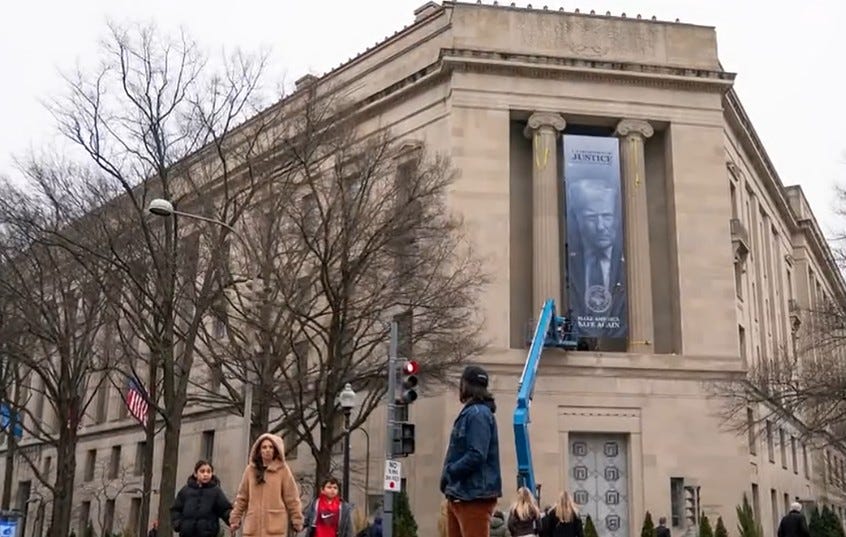
Sherrilyn Ifill, the civil rights leader and democracy warrior, is greatly alarmed by the confirmation of Trump’s personal lawyer Todd Blanche as attorney general, which she sees as “the surest and most devastating signal that the rule of law has collapsed in this country.”
Specifically, she writes, it “announces the beginning of an accelerated and frightening program of smothering dissent.”
The weaponization of the Department of Justice against protesters, journalists, and opposition figures now “has the sanction of a majority of the Senate,” she writes.
And she is issuing a (nonviolent) call to arms:
We have a very limited window to fight this. Whatever non-violent tools of resistance we have left must be deployed - boycotts, protests, litigation, general strikes, demonstrations. We must shame those who are prepared to sit on the sidelines or worse abet this madness. Corporations (who have shockingly even allowed Trump to nationalize percentages of their companies - the great fear they all claimed they had of the left) must be called out. What media we have left must be pushed to take up their proper role of informing the citizenry about the stakes of this moment. Faith institutions have begun to rouse themselves, but their actions must intensify.
She calls for a significant increase in outreach — “door-to-door, in churches, in community meetings, on street corners” — to help “ordinary Americans… understand the consequences of this latest outrage for their own lives.”
Similarly, Democracy Forward president Skye Perryman was talking recently about a substantial expansion of collective action. “The suggestion of massive boycotts, massive work stoppages — we may be at the place where that is going to be needed in this country,” Perryman said in a Zeteo interview:
Resistance organizers have long said that the next step in the resistance will involve. noncooperation tactics such as boycotts, walk-outs, sick-outs, sit-ins, strikes, and refusal to obey orders.
But how do we get from here to there? And when? I’ve been asking the same question for more than a year. It’s been five months since the last No Kings rally, and while there’s a really impressive amount of quiet organizing going on, where does that lead?
May Day was a trial run for a general strike -- “a structure test for the strength of the movement,” as Ezra Levin, co-founder of Indivisible, put it. And it was disappointing.
The next several months, of course, have another urgency. As Ifill writes:
[N]othing we do will matter unless we are able to mobilize massive turnout in the midterm elections. If this election does not give Democrats the power to hit the emergency brake in January, this country will be in freefall. And if the Democrats get that power and hesitate to use it, this country will be lost.
Haitians in Limbo Get Community Support
Some 330,00 Haitian immigrants who were living legally in the United States under the temporary protected status (TPS) program officially lost that status last week.
The Springfield News-Sun in Ohio reports that over 500 people gathered outside the Blue Ash ICE office before 7 a.m. for a second Sunday in a row to show support for Haitians who were called to report for immigration check-ins.
ICE officials, as I wrote last week, only allowed the immigrants to leave shackled to bulky black ankle monitors. “It’s pretty much just a constant reminder of the fact that they’re being treated like criminals when they’ve done nothing wrong,” Kelly Sheehy, director of development and communications for Ignite Peace, one of the rally’s organizers, told the News-Sun
Monsanto Maler, who traveled from Springfield for his check-in, collapsed to the ground crying after he left with a monitor on his ankle. Faith leaders prayed with immigrants and offered communion.
The Philadelphia Inquirer reported that “Dozens of Haitians, allies, and supporters rallied in Center City on Thursday, demanding that Pennsylvania’s U.S. senators help restore temporary protected status (TPS) for thousands now in danger of being deported to the shattered Caribbean nation.”
The Inquirer notes that “Community leaders fear mass family separation, as Haitian nationals have married U.S. citizens and are raising American-born children.”
NY1 reported on a rally by healthcare workers outside Maimonides Medical Center in Brooklyn. Public Advocate Jumaane Williams urged New Yorkers to be vigilant but nonviolent. “Get your whistle. We want to make ICE as uncomfortable as possible, and make it as difficult as possible for them to do their job,” he said.
Deadly Delaney Hall
The New Jersey Monitor reports that “Democratic lawmakers met in a Morristown church Tuesday to repeat calls to shut down Newark immigration jail Delaney Hall and raise alarms about medical care for detainees held there.”
House Minority Leader Hakeem Jeffries was there. “Three deaths at Delaney Hall -- completely and totally unacceptable. Fifty-five deaths in ICE custody since the beginning of Donald Trump’s time in office, over the last 17 months or so,” said Jeffries. “That means one death in ICE custody every six days. That is not America.”
New Jersey’s attorney general Jennifer Davenport has launched a civil rights investigation into conditions at Delaney, where two deaths came within a two-week period.
Edwin Jovanny Lopez Cornejo, a 39-year-old Salvadorian who was held there after he was arrested by federal immigration agents in June died on August 3. His mother told the Monitor Cornejo was supposed to be taking daily medication for diabetes and high blood pressure, which he was not receiving at the jail.
Another Delaney detainee died in late July -- but ICE did not publicly disclose the death. Rep. Rob Menendez told the Jersey Vindicator that he was told the man had a seizure during intake. The Vindicator reported that “EMS workers arrived about 30 minutes later and took the person to University Hospital in Newark, where the detainee died shortly afterward.”
Menendez, outraged, said that ICE said it did not publicly report the death because the agency had granted the man a “discretionary release” and therefore he “was technically no longer in ICE custody.”
They could do that because, as the N.J. Spotlight reported, the Trump administration in June cast aside a key Biden-era rule that required ICE to report to Congress and investigate the deaths of any former detainees within 30 days of release. “The policy was designed to thwart the agency from releasing seriously ill individuals in an attempt to avoid legal responsibility for them,” the Spotlight reported. “ICE called the reversal ‘common sense.’”
In D.C., One Year of Occupation
FreeDC marked Tuesday as the one-year anniversary of “hostile military occupation”:
Joseph Nunn, a counsel in the Brennan Center’s Liberty and National Security Program, wrote in The Hill that Trump wants “to keep troops here through Jan. 20, 2029, at an estimated cost of $1.4 billion beyond the money already spent.”
Nunn wrote that “The duration of the deployment might be what’s most concerning. No true emergency can be predicted to remain in place for another two-and-a-half years. If there was any doubt before, it’s now clear that the deployment was never meant to be a quick response to an immediate crisis.”
So what’s the point? Nunn pegged it:
It is designed to normalize something that should never be normal in this country: the use of the military as a domestic police force. It would be a small step from National Guard forces assisting in the arrest of people who dip their hands in the reflecting pool to guard members policing protests. And if Trump were to try to illegally block Congress’s certification of the 2028 presidential election — this time using military force, rather than exhorting an angry mob — there would be thousands of troops already arrayed within a short distance of the U.S. Capitol.
Resistance Hero
Carolina Molina, a suburban Virginia counselor who works with immigration lawyers, stood her ground Monday after a masked ICE agent pointed a gun at her through her car window.
Molina posted shocking videos on her Instagram page, where she goes by tinyandstrongthings. The first one showed the furious agent threatening her and insisting “you almost ran us over”.
Molina responded: “You are full of shit” and “I got dashcam!” She refused to move. “I ain’t scared of y’all,” she said.
The dashcam video shows she was not close to the ICE agents when she drove by and called them a hoe. Then she turned around and called them “a fucking bitch.” That’s when an ICE SUV cut her off and agents surrounded her.
Molina told WUSA9 that she wants accountability and does not regret what she said to the agents. “I know my laws. I’m an American citizen. I have the right. I have my First Amendment rights. I can say what I want, and I don’t feel like I should have a gun pointed to my head because you didn’t like being called a hoe,” she said.
And just in case you couldn’t distrust DHS any more, they’re compounding the lie.
DHS told News4 that “an anti-ICE agitator… attempted to harm officers by weaponizing her vehicle against them -- all in an attempt to help illegal aliens get away.”
It added: “Fearing for their safety, ICE officers conducted a vehicle stop of the driver. Necessary background information of the driver was taken and she could face criminal prosecution as a result of her actions.”
There is no bottom.
Or as Molina put in on Instagram, “They’re full of shit.”
This Week in the Courts
A federal judge in Massachusetts has expanded her injunction against Trump’s executive order attempting to seize control of mail-in voting to cover the whole country. Dueling appellate court decisions, however, mean the future of the order is up to the Supreme Court.
A Washington, D.C. judge has brought the DOJ’s record to 0 for 21 in its attempts to demand unredacted voter registration rolls from election officials. As Democracy Docket reports, a DOJ lawyer insisted to Judge Kymberly Evanson that all the other courts got it wrong. She disagreed.
A federal judge in Texas released Guatemalan national Faustino Pablo Pablo from ICE detention after what TPM’s Morning Memo describes as “a surreal nine-month journey through the worst of the Trumpian immigration system compounded by highly misleading representations — if not outright lies — by the administration in court.”
A Washington, D.C. superior court judge ordered the John F. Kennedy Center for the Performing Arts to pay musician Charles Redd at least $252,479 in legal fees after he dismissed the center’s lawsuit against Redd for backing out of a free concert last year in protest of Trump adding his name to the institution.
A Rhode Island federal judge has ordered the Department of Housing and Urban Development to vacate its most recent attempt to shift federal funding away from permanent housing for people who were experiencing homelessness. Advocates said HUD’s moves would have pushed nearly 200,000 Americans into homelessness.
The Trump Department of Labor, in a settlement agreement filed in federal court, has agreed to rescind its efforts to shutter 99 Job Corps centers nationwide. D.C. District Court Judge Dabney L. Friedrich blocked the closings last year for likely violating provisions of the Workforce Innovation and Opportunity Act. The department will also pay $50,000 in legal fees to Public Citizen, which represented the plaintiff students.
The Intercept and the Freedom of the Press Foundation have filed a federal lawsuit against Trump for “charging $100,000 per month for advance access to his official government announcements on Truth Social, the social media platform he owns.” They call the scheme “extraordinary, corrupt, and unconstitutional.”
Independent journalists Don Lemon and Georgia Fort have both filed motions asking a Minnesota federal judge to throw out their ridiculous criminal conspiracy indictments for covering a protest in Minneapolis. They filed several other motions to dismiss as well. You can find them all in the public docket. DOJ’s Civil Rights Division has thus far responded only by complaining that one of Fort’s motions had too many words.
Former federal prosecutor Will Rosenzweig filed suit against the DOJ for firing him for a blog he published as a private citizen before he entered government service. As the New York Times reports, Rosenzweig “joined a growing list of former prosecutors and federal agents who have gone to court in an effort to fight back against the widespread purge of law enforcement officials deemed to be disloyal to the president.”
Reuters has identified 75 federal-judge rulings finding that Trump’s government infringed on First-Amendment rights including freedoms of speech, religion, and the press. “The unprecedented pushback on constitutional grounds has included repeated findings that the administration chilled or squelched the speech of citizens and groups opposing the Republican’s agenda,” the news service reported.
This Week’s Must Reads
From The Nation: “One Woman’s Message From the Hell of ICE Detention.” Maryam Tahmasebi and her husband and son have been locked up for months. “We need your help,” she writes. “We are in tremendous pain and have been trapped in an unendurable, unending nightmare. I want my son to have a normal life, not spend his days in this awful detention center in Dilley. No child deserves this. No human deserves this.”
From the New York Times: “‘Shame!’: An ICE Facility Roils a Tiny Town, With a House Seat in Play” about tiny Hudson, Colo., which was mostly known as a speed trap until ICE announced it was coming, setting off months of protests.
An opinion column from author Donna Cameron in the Seattle Times: “In politics, maybe ‘resist’ isn’t enough. It’s time to press forward”. “I am not the resistance,” she writes. Trump “and the sycophantic zealots he surrounds himself with are the true resistance.”
This is a great one, Dan.
I was expecting this summer to be packed with protests and rallies. That’s why I wrote and posted a dozen protest songs.
But I guess summer vacations were deemed more important by the “resistance.”