


May 1 is traditionally a day to celebrate and flex the collective power of workers, led by unions.
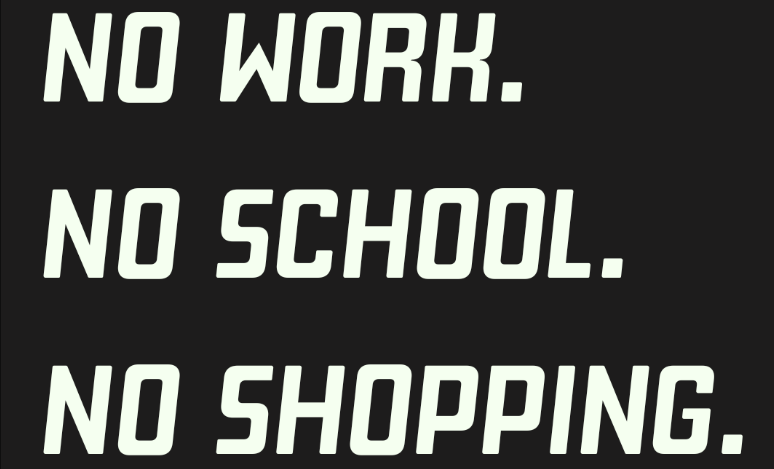
This year – this Friday – it is that and more, as a huge coalition of resistance groups are calling on every American to participate in a one-day stoppage of work, school, and shopping to protest billionaires, ICE, the war, and the assault on democracy.
The goal is not just to come together, like at a No Kings rally, but to disrupt business as usual – to force people to pay attention to the crises we are in and the ways to fight back.
The only way that goal will be achieved, however, is with massive union participation. So just as May Day this year is a trial run for a possible general strike, it is also a consequential test of union muscle.
Will business be disrupted in Chicago, or Philadelphia, or Los Angeles, or New York? Or will there be no noticeable effect? It will largely depend on the unions.
In Chicago, for instance, major unions are explicitly calling for an economic blackout there and are planning neighborhood rallies, school block parties, and protests against Amazon, Target and an ICE detention center before marching to Union Park for a mass rally and march through downtown and to Daley Plaza.
Philadelphia could be a hotspot. Some of us had high hopes for May Day last year as well, but pretty much the only place they were realized was in Philadelphia, where a massive crowd gathered outside city hall, and 70 unionized hotel and food service workers were arrested during a peaceful sit-in at a busy downtown intersection.
One group to watch particularly closely is the teachers’ unions. For instance, many North Carolina school districts will be closed on Friday after the state teachers union called on educators across the state to walk out of work and join a rally in Raleigh. Their May Day rally, they say, “represents the culmination of growing frustration among educators, students, and communities over the state’s continued failure to adequately invest in public schools.”
I wrote last week about how this year’s May Day is a major tactical escalation for the resistance. One organizer called it “a structure test for the strength of the movement.”
Organizer Neidi Dominguez told the Guardian there will be more than 3,000 events around the country. But at the same time, she kept expectations low. “We have a long way to go to take massive disruption actions like in other countries, where people will go on general strikes and they can shut down their country, but I think we’re getting more and more close to people having consciousness about their own power as workers,” she said.
Dana Fisher, an American University sociologist who studies protest movements, said there will be something to cheer either way:
Even if May Day Strong does not stop the economic workings of the US for the day and is not clearly noticeable to everyone, these events can still build power…. May Day Strong has the potential to expand the Resistance toolbox by exposing people across the US to a wider range of civic tactics that we can all use to channel our power and push back to autocracy.
In the Philadelphia Inquirer, columnist Will Bunch wrote that he fears the mainstream press – “already too dismissive of the pro-democracy resistance” – will spin May 1 as a step backward compared to the No Kings 3 protest that brought out eight million people. He continued:
Still, there is substantial work behind the scenes that could make the May 1 action a big enough success that it would surprise the more somnambulant general public, and maybe create some momentum for bigger and bolder actions down the road….
Don’t let the media negativity or the passivity that’s weighed down too many citizens for far too long cloud your own feelings about a Mayday signal for a fast-sinking American democracy. Look at this action as the beginning of something. Where it ends is up to us, the people.
So, people, find a May Day event near you. Don’t go to work. Don’t go to school. Don’t shop. And if you need to be psyched up, there’s a final mass call tonight at 8 p.m. ET.
Communities Not Cages
Inhumane and unwanted ICE detention centers were the focus of Saturday’s “National Day of Action” events all over the country. Protesters were particularly energetic in places that are fighting the construction of new detention centers in local warehouses.
MS NOW’s Rachel Maddow, uniquely, captured their significance.
Here’s part of what she said:
I recognize that I am part of the national media. So therefore, I am a little self-conscious about the fact that the national media has really been sucking its thumb on this story and hasn’t much caught on to it yet…. But local media have been taking notice of these fights everywhere they are happening. And local media everywhere this weekend took notice of these protests that happened in more than 180 different locations all over the country.
So check out some of those local reports from Romulus, Michigan; Tucson, Arizona; Marietta, Georgia; Portland, Maine; Salt Lake City, Utah; Hagerstown, Maryland; McHenry, Illinois; and Socorro, New Mexico.
How effective is the local opposition to converting warehouses into concentration camps? It’s so effective I can’t even keep track. But luckily Project Saltbox is doing just that.
This Week in the Courts
Today’s Supreme Court decision effectively dismantling what was left of the Voting Rights Act of 1965 is a huge blow to our democracy. But there were, as usual, some significant resistance victories in the courts this past week:
The 2nd Circuit Court of Appeals – disagreeing with the 5th and 8th circuits – ruled against the Trump administration’s policy of locking up most immigrants it intends to deport without access to a hearing that could lead to their release. The ruling declared the move contrary to the plain text of the law, and called it “a radical break from the past” that “would send a seismic shock through our immigration detention system and society, straining our already overcrowded detention infrastructure, incarcerating millions, separating families, and disrupting communities.” Note to the judges: That has almost all happened already.
The Court of Appeals for the D.C. Circuit blocked Trump’s day-one executive order claiming the power to summarily deport asylum seekers who cross the border without allowing them to seek protection as required by Congress. The ruling concludes that Trump’s order and subsequent guidance “circumvent Congress’s carefully crafted removal procedures and cast aside federal laws that afford individuals the opportunity to apply and be considered for a grant of asylum or withholding of removal.”
A federal judge in Arizona has thrown out a DOJ lawsuit demanding the state turn over its voter rolls. The government’s arguments were so flawed that Judge Susan Brnovich wrote that she was dismissing the case “with prejudice because amendment would be legally futile.” It’s the sixth straight loss for DOJ’s attempt to get states’ voter rolls.
Federal prosecutors in Chicago are dismissing the conspiracy counts against the remaining four members of the “Broadview Six”, the people arrested after protesting outside ICE’s Broadview detention center in September. The judge had ordered prosecutors to turn over transcripts showing how they had explained the law in the case to grand jurors. Rather than do that, they dropped the charges.
I have written admiringly about how federal district court judges keep issuing rulings that boldly defy the Trump administration’s onslaught on the rule of law. And here’s a neat bit of analysis: Politico’s Kyle Cheney has counted “420 district judges who have ruled against ICE’s mass detention policy — now backed by the 2nd circuit — [compared] to 47 who have ruled in favor. Among Trump appointees, 51 have ruled *against* the administration to 37 in favor.”
BRUUUUUCE
Four weeks from now, Bruce Springsteen brings his “Land of Hope and Dreams” tour to Nationals Park. I can’t wait.
This wonderful essay by political strategist and Springsteen fanatic Jamison Foser describes the Boss’s “confidently, unapologetically, thoroughly political show.” Foser writes:
It’s an almost preposterously ambitious thing to try to pull off a (nearly) three-hour political rally dressed up as a rock concert, but it works. It holds up because it is sturdy. It has roots. Springsteen has been preparing himself and his audience for it for fifty years.
And here is what Springsteen generally says to close out his show:
Find a way to take aggressive, peaceful action to defend our country’s ideals. And as the great civil rights leader John Lewis said, go out and get in some good trouble. Say something. Do something. Hell, sing something. That’s all that I do. If you’re feeling helpless, hopeless, betrayed, frustrated, angry: I understand. I have felt that way too. … That’s why the E Street Band is here tonight. Because we needed to feel your strength and your hope. And we needed to bring you some strength and some hope in these times. I hope we’ve done that for you tonight. God bless Alex Pretti. God bless Renee Good. God bless you. And God bless America.
End Notes
The New York Times explains why the American Association of University Professors is booming: “A Professor Union Grows Fast as It Ramps Up Its Fight Against Trump.”
A former GOP Senate counsel writes in the Atlantic that “if the Madisonian republic is to endure, conservatives must reckon with our role in bringing the nation to its current breaking point, and work to reestablish the checks and balances that we helped erode.”
Russell Berman writes in the Atlantic that Thomas Massie, the renegade Kentucky Republican, thinks that if he wins his May 19 primary against a Trump-backed challenger his victory will embolden more Republicans in Congress to stand up to the president.
And read Nesrine Malik’s opinion column in the Guardian: “Trump’s presidency is what evil looks like: absurd, frightening, cruel.” I mean, she kind of nails it, doesn’t she?
Please give yourself the day off on May 1st!