


(Happy Holidays and Happy New Year! Heads Up News will resume on Jan. 7)
Resistance groups are looking ahead to 2026 and making plans.
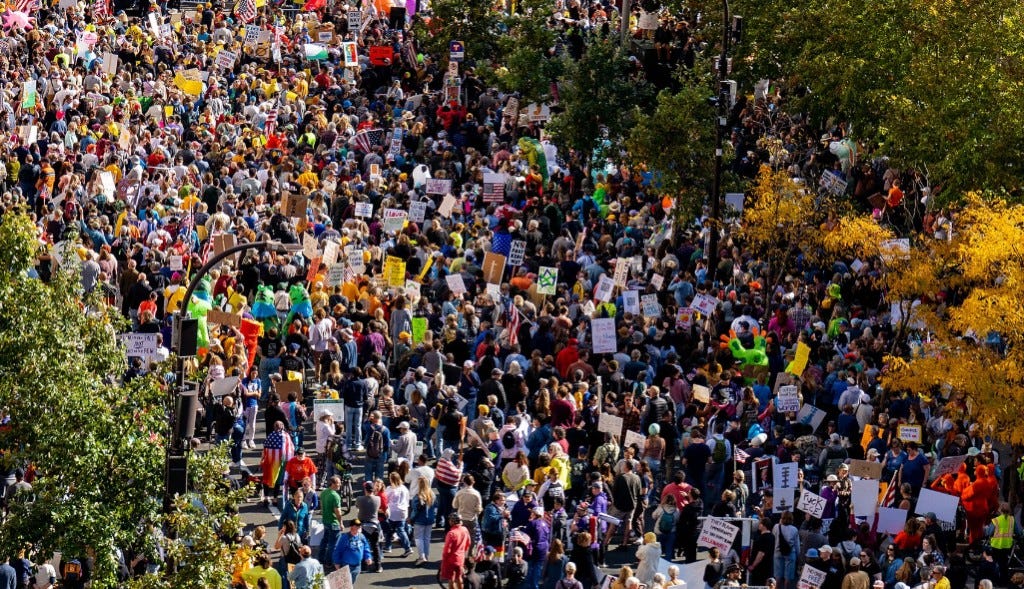
MoveOn intends to mobilize more people. A lot more people. Katie Bethell, MoveOn’s executive director, said in a call this week that mobilizations like No Kings “need to grow.”
“Seven million people in the street in October was amazing,” she said. “What an accomplishment! The largest single protest day in America! And next year, we need to double that. We need to triple that to fight back against what’s happening in this country.”
Indivisible is turning a lot of its attention to the Democratic primaries and then the general election.
“Ready to turn the page on failed Democratic leadership?” the organization asks. “The clock is ticking, and we don’t have time for dead weight in the Democratic Party. It’s time to clean house.”
The goal is to elect Democrats who will “fight like an actual opposition party to an authoritarian regime.”
I wrote a couple weeks ago about Public Citizen’s 2026 plans for litigation, investigation, and advocacy in areas including Trump’s grift, health care, corporate subsidies, immigrant rights, and open government.
The leadership team at Protect Democracy is optimistic. “We are going to win,” Isaac Gilles and Ian Bassin wrote last week. Trump, they believe, “is losing the race against time and has failed to sufficiently consolidate power before becoming deeply unpopular, which was the recipe we knew would be necessary to prevent a full-on collapse into autocracy.”
They acknowledge that “extreme danger still exists for our democracy, and many communities in our country still live in daily terror from the regime’s abuses,” but they argue that “we can now see a path to defeating the autocratic assault and turning this crisis into opportunity.”
Protect Democracy’s goals for 2026 include protecting electoral infrastructure and processes from interference, and “protecting an open civic landscape in which all Americans can dissent, organize, share and receive accurate information, make arguments for and against political platforms, express and provide support for political candidates, and compete for power free of intimidation and censorship.”
Democracy Forward, which filed dozens of lawsuits against the Trump administration in 2025, has more coming. “Our hallmark at Democracy Forward is being ready for what’s next,” the group says in its “2025 Impact Report”:
We are prepared to fight for democracy in our communities, in our courts, online, and everywhere in between. And, we are launching ground breaking initiatives to bring more people into the fight for democracy — and to reimagine what our nation can look like if the government truly works for and serves all people.
I’m particularly enthusiastic about the group’s new DemocracyWorks250 initiative. Its goal is “to reimagine the foundations for an American government that serves all people with integrity, innovation, and accountability – and to match that vision with the work required to build an innovative model for governing.”
I think it’s none too early for the pro-democracy community to start developing specific plans for a post-Trump America: a ready-to-implement guide to rebuilding a government and constitutional order that are more robust and more responsive to the people’s needs.
And I hope to report fairly extensively in the coming year on the people and groups who are doing that thinking and planning.
Vibe Shift?
In my Dec. 3 newsletter, I wrote about the “vibe shift” in New York City as protesters were on offense rather than defense, boxing in ICE agents before they could even get out of a garage.
I suspect something similar may be coming to the national resistance in 2026: Not just more and bigger protests, but also noncooperation, including mass boycotts, walkouts, and civil disobedience.
Lee Morgenbesser, an Australian government professor, wrote an insightful essay on Sunday in The Conversation, arguing that “Mass protests are laudable, but insufficient.”
He offers seven lessons “from those who have resisted authoritarian rule around the world.”
He advises, for instance, that there should be many more protests, more often. “The Democratic Party needs to use its national infrastructure to launch sustained mass protests. Otherwise, it risks becoming a mere bystander to Trump’s authoritarianism.”
He recommends “spontaneous protests” – such as at the Supreme Court, the next time it rules in Trump’s favor.
He urges someone to “create a mobile app that provides citizens with real-time information on every company tied to the administration, so people can make more informed consumer choices.”
His other lessons:
Embrace the power of comedy
Carry out civil disobedience
Tell stories of courageous individuals
Prepare for flawed elections
Minnesota Rejects ICE
I wrote last week about the many acts of resistance documented in the Minneapolis area. They continue. Now with snowballs. Which, to ICE agents, are apparently terrifying.
Minnesota Public Radio reports:
A pair of ICE agents found themselves surrounded by outraged neighbors and activists during an attempted immigration arrest in south Minneapolis on Monday afternoon.
Observers said the officers were attempting to arrest a woman in a traffic stop north of Lake Street and Pillsbury Avenue at about 1 p.m. Video shared with MPR News shows agents restraining a woman on her stomach on the icy ground, then dragging her on the road towards their vehicle as bystanders and activists hurled insults and snowballs in their direction.
The agents used pepper spray, pepper balls and tasers on bystanders, according to the videos. One agent is seen wildly swinging a baton to keep protesters at bay before apparently getting hit by a colleague’s pepper spray.
The agents’ supervisor called Minneapolis Police and the Hennepin County Sheriff’s Office to rescue them. “They’re surrounded and they’re being attacked,” the supervisor said. (The sheriff’s office posted audio of the call on Facebook). “We only have a few officers but we have 60 to 70 agitators that are fighting us,” the supervisor said.
The sheriff’s office noted drily: “Upon arrival, our deputies did not witness any attacks or any agents needing medical attention.”
ICE released a statement on Tuesday saying that agents arrested two U.S. citizens for assaulting federal officers, WCCO reported. ICE claimed that “officers sustained multiple injuries, including cuts,” which seems unlikely, given that it was snowballs — and taking into account their track record of lying.
On Saturday in Chanhassen, just southwest of Minneapolis, federal agents tried to detain two men working at a construction site, trapping them on the roof in subzero temperatures. It turned into a standoff.
As Fox 9 reported, a “large crowd surrounded and confronted” the ICE agents. People in the crowd gave the men blankets, warm drinks and food. “It’s mind-blowing that people are out here, -20 plus degree weather, building houses for our community members, and they’re being targeted by ICE,” one member of the crowd told Fox9. Here’s the raw video.
MPR reports: “One worker was eventually brought down with a boom lift and taken into an ambulance. A Mercado Media livestream shows an ICE agent joined in the ambulance. It also shows the second worker came down around 1 p.m. and left the scene without being detained.”
And on Thursday night, activists targeted a hotel southwest of Minneapolis that was said to be hosting ICE agents. Video here and here.
The Star Tribune reported:
At 7 p.m. Thursday, more than 100 people gathered outside the Homewood Suites by Hilton in Edina to protest the hotel reportedly hosting ICE agents.
They came with drums, loudspeakers, megaphones and car horns and a goal to make as much noise as possible.
“Our main goal is to let these hotels know that we don’t tolerate their collaboration with ICE,” said Megan Newcomb, an organizer with the Sunrise Movement, which focuses on climate policy and investment in working-class communities. “We’re also here to let these ICE agents know that we don’t want them here.”…
The hotel is the third that protesters have appeared outside of in the last week. At least one demonstration occurred in early-morning hours.
The Scene in Chicago
Border Patrol chief Greg Bovino, who has become the face of violent immigration raids, is back in Chicago along with about 200 agents, Block Club Chicago reported. He arrived in a caravan, which “frequently blew red lights, blocked roads and cut in front of busy traffic as some protesters in trailing cars followed suit.”
“It’s going to be a merry Christmas in Chicago,” Bovino told Block Club reporters.
Immigration enforcement “was notably subdued and there were fewer confrontations with less violence” while Bovino was gone, Block Club reported.
On Tuesday, Bovino paraded around, holding a long gun to his chest, as agents rousted and arrested random brown-skinned people. The Chicago Tribune called it “a seemingly made-for-television jaunt” and reported:
The agents made several arrests in supermarket parking lots and tamale stands — detaining a man who has lived in the U.S. for about 20 years and was described as hardworking and humble by his daughter — while goading angry residents who confronted them and threatening to unleash tear gas.
So, yes, Chicago resident are leaping back into action, reprising what had been an effective resistance when Bovino was there from September to November.
In the New Republic, Melissa Gira Grant writes from “Inside Chicago’s Neighborhood ICE Resistance”:
The one response that has been genuinely effective has come from community members—ordinary residents who have come together, trained one another, and connected across neighborhoods to form groups like the Southwest Side Rapid Response Team. They have eyes on the street, the trust of their neighbors, and the ability to intervene practically instantaneously, sharing information with the ICE-activity hotline that operates across the state. They can record evidence and pass it along in seconds to rights groups, news media, and social media. Blending protest and direct action, they are offering something concrete to Chicagoans who want to express their opposition to Donald Trump’s war on immigrants.
The Scene in New York
Hunter Walker, a reporter for Talking Points memo, spent two months reporting on the effect of Trump’s mass deportation agenda in New York. What he found is this:
Across the city, there is something of a modern underground railroad with programs offering services to migrants including food, clothing, and free clinics that provide advice and assistance with legal proceedings. Volunteers are also accompanying migrants as they face the gauntlet of masked ICE agents waiting in the halls of the courts downtown.
Stories in the series so far:
“Inside the Secret Network Offering Sanctuary to Immigrants Amid Trump’s ICE Onslaught”
“The Undocumented Underground Is Fighting Back Inside New York’s Notorious Immigration Court”
“Underground Legal Clinics Offer a Lifeline to Migrants Facing Mass Deportation”
“Secretive Rapid Response Networks Are Operating in Communities ‘Terrorized’ By ICE Raids”
The Scene Around New Orleans
Before he left the New Orleans area, Bovino stormed down the streets of Kenner, Louisiana, hounded by protesters blowing whistles and shouting to warn residents not to leave their homes. Here’s video.
MS NOW’s Alex Tabet rode around New Orleans with the Reverend Jane Mauldin, a 71-year-old Unitarian pastor who spends her free time monitoring vehicles she believes are ICE and Border Patrol officers to alert residents when federal agents are in their area.
“I want my children and my grandchildren, and their grandchildren to have a democracy in our country,” Mauldin said. “If we don’t act right now, I’m afraid that could be lost. So I have to act.”
The Scene in Los Angeles
The last of the California National Guard are out of Los Angeles, thanks to a court order issued last week. The Los Angeles Times reported:
Dozens of California National Guard troops under President Trump’s command apparently slipped out of Los Angeles under cover of darkness early Sunday morning, ahead of an appellate court’s order to be gone by noon Monday.
Meanwhile, the Nation looks back at “How LA Defeated Donald Trump”:
LA showed the country that resistance and solidarity work: When people organize and stand firm, even a president bent on repression can be pushed back. If Trump thought Los Angeles would be the model for his authoritarian power grab, what he got instead was the template for defeating it.
The Scene in Oregon
The Oregonian reports that an estimated 1,600 middle and high school students walked out of classes Friday morning in Hillsboro, near Portland, to protest ICE activity in their communities.
“We never expected this many people,” a Hillsboro High School junior named Diego, who helped organize the protest, told the Oregonian:
“This means a lot to all of us, those who were impacted by ICE, the terrorism that ICE has been inflicting on our community,” Diego told the crowd at Shute Park. “My parents work so hard, and now they’re living in fear because of what’s going on. My two uncles, they were detained two weeks ago. I’m doing this for them and for everyone else who has been taken.”
Several nearby high schools led smaller walkouts earlier last week.
The Scene in Massachusetts
The Boston Globe reports:
On a frigid night, protesters Tuesday held an “ICE Tea Party” on the Boston waterfront to protest US Immigrations and Custom Enforcement policies and action.
They dumped ice into Boston Harbor, a moment of dramatic irony on the 252nd anniversary of the Boston Tea Party of 1773….
“We descend from Immigrants and Revolutionaries,” read a battle cry beamed onto the side of the brick meeting house Tuesday.
The Scene in San Francisco
Rabbis and priests engaged in civil disobedience on Tuesday in San Francisco. CBS San Francisco reports:
Protesters chained themselves together in front of a federal immigration services building in San Francisco on Tuesday morning, prompting authorities to shut down the building for the day.
Dozens of religious leaders were taken away in handcuffs after blocking the front doors of the U.S. Immigration and Customs Enforcement field offices on Washington Street near the city’s Financial District. Protestors blocked the entrance for about five hours, beginning at about 6 a.m. until federal police arrived.
Bipartisan Resistance!
It’s a first. A bipartisan majority of the House voted to reverse a Trump executive order. As Politico reports
The House on Thursday voted 231-195 to pass a bill that would restore collective bargaining rights for federal workers, a first step toward reversing the sweeping changes President Donald Trump enacted earlier this year.
Twenty Republicans joined all Democrats to advance the Protect America’s Workforce Act....
The legislation would roll back Trump’s March and August executive orders that stripped collective bargaining protections for large swaths of the federal workforce.
Nativity Scene Update
Last week, I mentioned the nativity scene at the Lake Street Church of Evanston, in which the Baby Jesus is zip-tied. Well, the Chicago Tribune reports:

Vandals decapitated and smashed the statue of Mary in an Evanston church’s outdoor Nativity scene Friday, and the church responded, according to an associate minister, by replacing it with a sign saying Mary was beaten and dragged away in front of her son and is being held in immigration detention.
End Notes
Yaqiu Wang writes in the Guardian: “I’m a Chinese pro-democracy activist. Here’s how to find courage to oppose Trump.”
“Trump Immigration Cruelty Fuels Surge in New Candidates,” writes Adrian Carrasquillo in the Bulwark.
Steven Levitsky, Lucan A. Way, and Daniel Ziblatt, experts in competitive authoritarianism, write about “The Price of American Authoritarianism” in Foreign Policy. “The outcome of this struggle remains open,” they say. “It will turn less on the strength of the authoritarian government than on whether enough citizens act as though their efforts still matter—because, for now, they still do.”
And I’ll leave you with these words, attributed to the late great Rob Reiner: “Speaking out is a patriotic act. Democracy doesn’t defend itself. It requires participation, vigilance, and courage from ordinary people.”
He gave a concession speech but did not mention President Biden by name. He still does not really concede because he makes false claims of voter fraud.
I was wrong about the year, sorry, but 2020 is the year that we saw that the Republicans supported Trump in not conceding, which led to where we are now. They will continue this insurrection as far as we let them.