


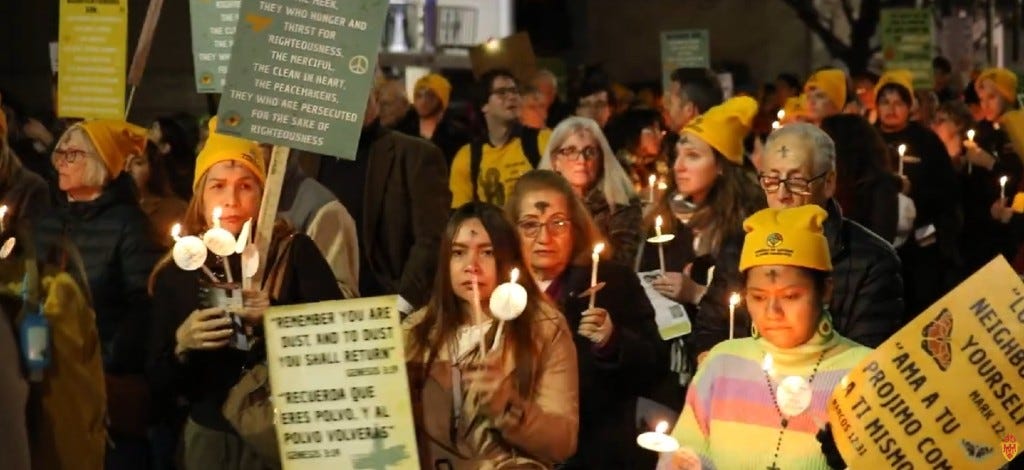
This year, for an increasing number of Christian faith leaders, observing Lent has brought with it the obligation to speak out against the inhuman cruelty the Trump administration has inflicted on the country’s immigrants.
Lent, the 40-day period of reflection and repentance leading up to Easter, began on Ash Wednesday last week.
Let’s start with Pope Leo, who has consistently been a proponents of immigrant rights. In his message for Lent this year, the pope encouraged more empathy with immigrants:
It would be a good Lenten exercise for us to compare our daily life with that of some migrant or foreigner, to learn how to sympathize with their experiences and in this way discover what God is asking of us so that we can better advance on our journey to the house of the Father….
This Lent, God is asking us to examine whether in our lives, in our families, in the places where we work and spend our time, we are capable of walking together with others, listening to them, resisting the temptation to become self-absorbed and to think only of our own needs….
Let us ask ourselves …[w]hether we show ourselves welcoming, with concrete gestures, to those both near and far. Whether we make others feel a part of the community or keep them at a distance.
In a statement issued yesterday, a group of 18 Catholic bishops and archbishops primarily from U.S. border regions was not nearly so subtle. They sternly urged a wholescale reversal from Trump’s immigration policies “in a manner that protects the God-given human dignity and rights of the human person.” Their list of recommended new policies:
The right to apply for asylum at the border should be honored.
Sensitive locations should be protected.
Immigration enforcement should not focus on those who are contributing to the nation.
Immigrant families should be kept together.
Due process should be restored in the immigration system.
The use of tactics to intimidate and create fear in the community should be halted.
Detention standards should be enforced and vulnerable groups should not be detained.
Congress and the administration should fund reintegration programs for deportees.
Among the specific asks:
The use of masks, random stops without probable cause, roving patrols, and physical abuse of immigrants and others has been well documented. Such tactics can intimidate immigrants, even those with a legal basis to remain in the US, and prevent them from asserting their rights. We urge that the use of these tactics be stopped.
Parts of their statement recalled a blistering November message from the entire U.S. Conference of Catholic Bishops that is worth reading in its entirely if you haven’t already. It said, in part:
We are disturbed when we see among our people a climate of fear and anxiety around questions of profiling and immigration enforcement. We are saddened by the state of contemporary debate and the vilification of immigrants. We are concerned about the conditions in detention centers and the lack of access to pastoral care. We lament that some immigrants in the United States have arbitrarily lost their legal status. We are troubled by threats against the sanctity of houses of worship and the special nature of hospitals and schools. We are grieved when we meet parents who fear being detained when taking their children to school and when we try to console family members who have already been separated from their loved ones.
Since then, bishops leading the conference have mourned the victims of violence at the hands of federal immigration agents, and decried plans to greatly expand detention. “The thought of holding thousands of families in massive warehouses should challenge the conscience of every American,” Bishop Brendan J. Cahill wrote. “Whatever their immigration status, these are human beings created in the image and likeness of God, and this is a moral inflection point for our country.”
On Ash Wednesday, the archbishop of Chicago, Cardinal Blase Cupich, led an outdoor Mass and candlelight vigil for more than 3,000 people expressing solidarity with vulnerable immigrants. Two priests and a nun, who had to sue to get access, gave ashes to detainees at the notorious Broadview ICE facility outside Chicago. And Cardinal Joseph Tobin, the archbishop of Newark, held two Masses inside that city’s detention facility.
And it’s not just Catholics, of course.
On Ash Wednesday, some 400 prominent Christian leaders issued “A Call to Christians in a Crisis of Faith and Democracy,” citing the need “for repentance and resistance, courage and conviction, faith and fortitude”:
We are facing a cruel and oppressive government; citizens and immigrants being demonized, disappeared, and even killed; the erosion of hard-won rights and freedoms; and a calculated effort to reverse America’s growing racial and ethnic diversity– all of which are pushing us toward authoritarian and imperial rule. What confronts us is not only an endangered democracy and the rise of tyranny. It is also a Christian faith corrupted by the heretical ideology of white Christian nationalism, and a church that has often failed to equip its members to model Jesus’s teachings and fulfill its prophetic calling as a humanitarian, compassionate, and moral compass for society….
We call on all Christians to join us in greater acts of courage to resist the injustices and anti-democratic danger sweeping across the nation. In moments like this, silence is not neutrality—it is an active choice to permit harm.
Writing for Sojourners, the Christian organization dedicated to social justice, author Kaya Oakes called on Trump supporters to repent for Lent.
Lent is a time for prayer, but also for action, and the action should cost you something and require real sacrifice. It is not enough to give up sweets or coffee and claim you’ve been changed, particularly when you’ve enabled a person like Trump.
Oakes asks the obvious question:
But what does repentance look like for the reformed supporter of Donald Trump? Is it even possible?
Then she answers it, at least sorta:
[F]or those trying to repent for their time in the MAGA movement, the most important lesson from Lent may be almsgiving…. It means meeting people face to face, hearing their pain, and understanding the role you may have played in it….
That doesn’t mean anyone who regrets throwing their support behind Trump should be forced to march through the streets in sackcloth (although many of us might confess to imagining just that), but repentance must involve a person facing up to the consequences of what they’ve done and committing to living differently, for good.
And for good measure, the progressive Christian organization Faithful America is asking everyone to give up supporting pro-Trump corporations for Lent.
The Children Shall Lead Us
Students continue to walk out of their schools to protest ICE all across the country. Increasingly, they’re doing so despite the prospect of punishment.
A little Googling turned up walkouts at high schools in Los Angeles, Bowling Green, Wisconsin, Fox Lake and Huntley, Indiana, and Chelsea, Michigan. Also at a middle school in Fitchburg, Massachusetts.
Students also walked out at ten Virginia Beach high schools, but 150 students at one of the schools were indefinitely suspended.
In Redlands, California, 150 students who walked out of their schools were punished with a suspension of extracurricular privileges until they attended Saturday school or performed four hours of community service.
Over 300 students at a high school in Prince William County, Virginia, were suspended for three days after leaving campus during an anti-ICE walkout.
A student walkout in Olathe, Kansas, ended in a melee, apparently after anti-ICE protesters confronted a group of students carrying pro-Trump signs. Four students were reported injured, and four were arrested .
The most outrageous walkout incident took place in Quakertown, Pennsylvania, where police chief Scott McElree, in plainclothes, suddenly began attacking a group of about 35 student protesters as they walked down the street. He even put one girl in a chokehold. Other students tried to fend him off. Police then arrested five of them and charged them with aggravated assault. Three were detained in juvenile hall for four days before being released; two others may still be in custody, it’s not clear.
Community members are calling for the chief to resign and the charges against the students to be dropped. The Bucks County district attorney is investigating.
At least two rallies for the “Quakertown Five” are scheduled for later this week.
There’s also a GoFundMe campaign to raise money for the students’ legal defense. It had an original goal of $18,000. It’s at $96,745 last I checked.
Concentration Camp Update
The Trump administration’s plans to set up an archipelago of new detention centers including massive new warehouses for people, should, as Philadelphia Inquirer columnist Will Bunch wrote, horrify every American.
But they also face widespread, bipartisan, and very effective local resistance.
Project Salt Box’s ICE Warehouse Purchase Tracker at this hour shows 12 warehouse sales cancelled, compared to nine that have been acquired.
The latest news is that the on-again-off-again plan for a new prison camp in Lebanon, Tennessee, is off again, after pushback from leaders of both parties, including Republican Sen. Marsha Blackburn.
After two months of public debate, DHS is trashing its plans for a detention facility in Merrimack, New Hampshire, WMUR reports.
DHS did buy a massive warehouse in Social Circle, Georgia, outside Atlanta. But the city manager of Social Circle says he’s not going to turn the water on unless his concerns are addressed.
Incidentally, it’s a mystery why DHS paid $129 million for the warehouse. That’s a cool $100 million more than the $29 million purchase price in 2003.
In Maryland, Attorney General Anthony G. Brown filed a lawsuit this week to stop the construction of a massive federal immigration detention center in Washington County.
Aaron Reichlin-Melnick, a senior fellow at the American Immigration Council, writes that if ICE gets its way, “the system of detention which has existed for generations may be fundamentally transformed into something even more sinister and more prone to abuses than ever.”
New York Times columnist Jamelle Bouie and concentration-camp expert Andrea Pitzer, both of whom have been leaders in calling out the inhumanity of DHS’s plans, discussed how these camps instill terror on the society as a whole. Read it.
Bringing Out the Best in People
The Guardian profiled Ashley Fairbanks, the founder of the Stand With Minnesota website that has raised almost $20 million for Minnesotans affected by the ICE raids.
Current Affairs published a feature on the extraordinary network of mutual aid in Minnesota “that supports vulnerable community members who are sheltering in place to avoid abduction by ICE and Border Patrol agents.” One collective, The People’s Laundry, is staffed by volunteers who wash clothes free of charge for those without access to laundry services.
And the Philadelphia Inquirer profiled José Hernández, a Bucks County man who delivers groceries to immigrants worried about attracting ICE attention.
This Week in the Courts
Here’s another barnburner ruling, this one challenging the Trump administration’s “mandatory detention” policy, which denies detainees the chance to seek release on bond. A federal judge in California ordered DHS to give newly-arrested immigration detainees notice that they may be eligible for bond -- and then give them access to a telephone to call an attorney within one hour. “Respondents have far crossed the boundaries of constitutional conduct,” wrote Judge Sunshine Sykes. She called DHS’s argument “shameless” and wrote that it “seeks to erode any semblance of separation of powers.” But, she wrote, “Respondents can only do so in a world where the Constitution does not exist.”
In a must-read order releasing a man from ICE detention, a federal judge in West Virginia declared Trump-era immigration-enforcement methods unconstitutional from start to finish. Judge Joseph R. Goodwin wrote: “Antiseptic judicial rhetoric cannot do justice to what is happening. Across the interior of the United States, agents of the federal government—masked, anonymous, armed with military weapons, operating from unmarked vehicles, acting without warrants of any kind—are seizing persons for civil immigration violations and imprisoning them without any semblance of due process…. It is an assault on the constitutional order. It is what the Fourth Amendment was written to prevent. It is what the Due Process Clause of the Fifth Amendment forbids.”
A federal judge in Minnesota has found the Trump administration in civil contempt for sending an ICE detainee to Texas in direct violation of his order not to remove the man from Minnesota. ICE eventually released the man without his belongings in El Paso. Judge Eric Tostrud ordered the government to refund the $568 the man’s cousin paid for a plane ticket home.
Four children being held in federal shelters while their asylum requests are under consideration are named in a federal lawsuit asking that they be reunited with their family members. Such children previously were released under the care of their parents or other sponsors. But now, when re-arrested by DHS, they languish in detention for months. The four represent hundreds of children in similar circumstances, as described in this November ProPublica article.
Lawyers for two Maine residents who lawfully observed and recorded DHS operations in public -- and were threatened and called “domestic terrorists” as a result – have filed a class action suit calling for an end to DHS’s unconstitutional surveillance and intimidation of Americans exercising their First Amendment right to bear witness to immigration operations in their communities.
Fifteen states led by Democrats are suing the Trump administration, seeking to reverse its latest vaccine recommendation for children, which would reduce the number of diseases prevented by routine shots to 11, down from 17. “Public health decisions must remain grounded in truth and facts,” said California Attorney General Rob Bonta.
Democracy Is Not a Losing Political Issue
I’ll leave you with this think piece from Vox’s Zack Beauchamp, who spent six months researching how to fight democratic backsliding.
He concluded that, contrary to what most Democratic leaders think, “Democracy is in fact a powerful motivating factor: When people are convinced that there’s a threat to their political freedoms, they can be motivated to go to extraordinary lengths to defend them.”
His message:
For the United States to make it out of its own crisis, we need to take this lesson to heart: not marginalize discussion of Trump’s threat to democracy, but bring it to the fore.
If Vox would explain to me how I can quit if I want, I’d join.
Thanks, Dan, for HOPE!
El Papa a favor de los Democratas y los Derechos Humanos, y aunque Dios no existe, la idea de que todo va a mejorar es el camino iniciado por la resistencia. Por ello, gracias a la resistencia el Papa ha continuado el mismo camino.Un acompañamiento espiritual positivo en casos
La fe mueve montañas, decían, claro que en un objetivio : destruir la Administración Trump.
Nunca es tarde .