


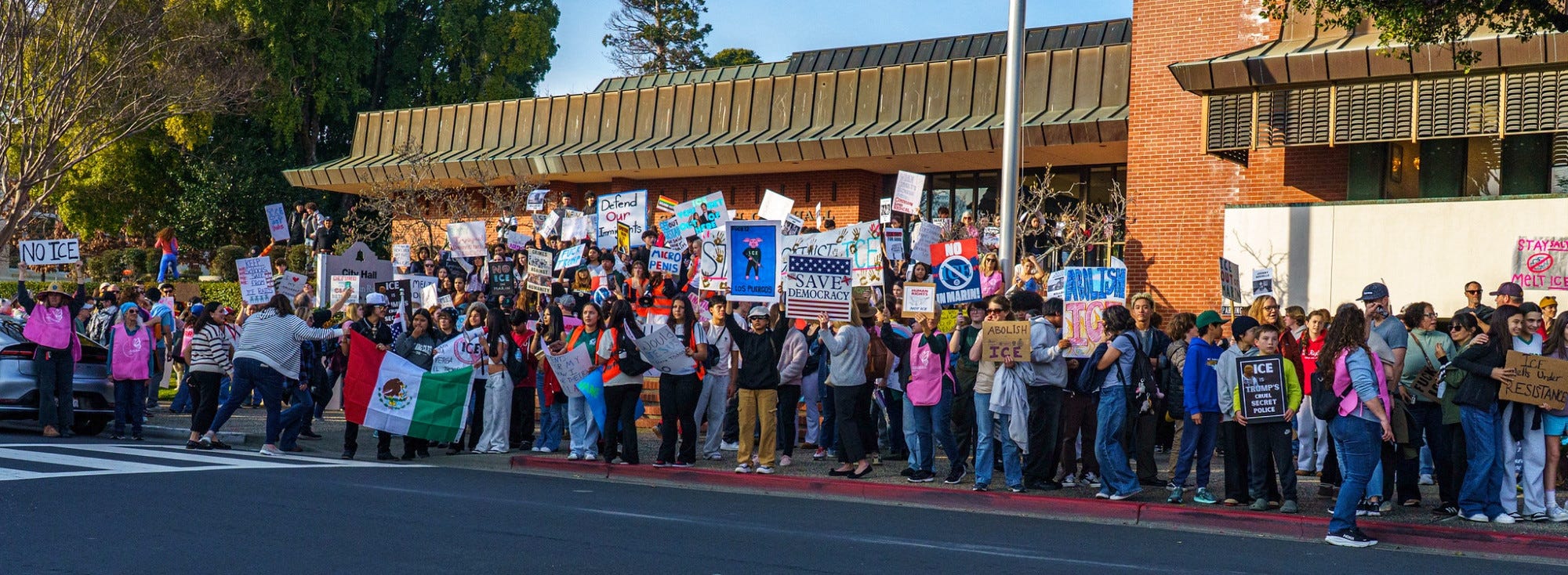
After months of resistance actions seemingly dominated by older adults, a wave of student activism is sweeping across the nation, with many thousands of young people walking out of classes to protest ICE.
The uptick in activity started on Jan. 30, as students in high schools, colleges, and even middle schools responded to a call for a national shutdown first issued by the Black Student Union at the University of Minnesota.
“Students are always at the heart of movements for justice across the world,” the organizations supporting the shutdown explained. “On January 30th, we will organize walkouts across the country and stand in solidarity with immigrant communities in Minnesota and everywhere else!”
Thousands of students heeded the call. And after January 30, the walkouts continued to spread – even in the face of threats from officials in some states, most notably Texas and Florida.
In Texas alone, just over the last few days, there have been student walkouts in Houston, Dallas, Fort Worth, the Austin area, San Antonio, and San Angelo.
As a particularly large walkout in Dallas just yesterday, students chanted “No Trump, no ICE, no fascists in our streets” and “ICE out, no justice no peace.” KERA public radio reported:
High school junior Landry Cannon, one of the organizers, said the students demanded U.S. Immigration and Customs Enforcement officers get out of Dallas.
“The atrocities they’ve been committing are not American ideals,” he said amid loud, chanting students. “This is what democracy looks like in our country, and we’re using our First Amendment rights to express what we believe.”
WFAA reported, also from Dallas:
Some students said the consequences did not deter them.
“I don’t think any punishment would have stopped me from coming out here today and being part of my school doing this. It’s powerful,” said Paola, a junior at Booker T.
For Paola, the issue is personal. She said her cousin, who was seeking asylum, was detained and deported.
“He and his wife and his child were here on asylum. They were here legally,” Paola said.
She said the protest reflects fears many students carry.
“As children, we should not be scared. But we are,” she said.
But for Paola, scared does not mean silent.
“If you feel like people are watching or even listening, trust me when I say they are,” she yelled over the megaphone to her classmates, as they cheered.
KVUE reported from Pflugerville, just outside Austin:
Eli Gutierrez, a junior at Weiss High School, described how they used social media to organize their walkout.
“Started on Instagram, and people started reposting, reposting, reposting, using the power of social media in a good way,” he said. “We’re all coming together, making an impact.”…
“Obviously, you saw Alex Pretti, Renee [Good] in Minnesota. Taking lives, man. This is ridiculous. So, we’re just here making a change,” he said.
In Florida, Central Florida Public Media talked to students about walkouts at all three Brevard County high schools last Friday:
Loren, a Satellite High School student, said she and her fellow protesters won’t be silenced, despite the district and the school board chair threatening disciplinary action. Fearing retribution, she asked that only her first name be used.
“There’s so many Hispanic people at our school that are afraid, and just it’s ridiculous what’s happening. There’s no reason for it, and there’s no reason to stop us from coming out here, other than you disagree,” Loren said.
The reporter also spoke to Nate, a Viera High School senior:
“I think it’s just they’re trying to scare us into submission and to silence our voices,” Nate said. “If we don’t use our voices to stand up for what we feel is right, whether you agree with us or not, I just think nothing’s gonna change. And we’re gonna have to live in this world when we grow up.”
Chalkbeat Indiana reported from Southport High School, outside Indianapolis, where the punishment for protesting was swift:
Southport students said that when they returned to school Tuesday, counselors and administrators began to call them down to dole out one-day out-of-school suspensions.
[Derek Stanley, a junior] said the prospect of his first-ever suspension from school initially made him nervous, but he was ultimately fine with the result.
“I’ve seen both in person and online people saying how scared they are. I wanted to speak about it,” Stanley said. “I’m glad I prioritized speaking out what I believe is right over three hours of school. Looking back, I would’ve regretted not doing it.”…
“One of the greatest things about America is we have a right to speak out and protest. I wanted to take a stand for what I believed in, ” said Ava Miller, a Southport junior who was suspended for the walkout. “Seeing what the world is like right now, I want to act on behalf of everyone being silenced.”
The Fresno Bee reported from the central valley of California
Sophia Nash, a senior at Clovis High, said she and some friends organized the protest because they were really upset with the deportation crackdown. “I think for a lot of us, this felt like a breaking point. One of my teachers was mentioning how a lot of people aren’t willing to protest or speak up until it’s their families, it’s their friends,” Nash said. “I think at our school, we waited too long to get involved, but we didn’t want to wait anymore. We didn’t want people to start getting deported or shot in our city.”
I’ve also seen reports of student walkouts in big cities and small towns alike, including Los Angeles, Philadelphia, Denver, Baltimore. Salt Lake City, Baton Rouge, Brooklyn, all over Seattle, Detroit, Little Rock, Louisville, suburban Chicago, Racine, Wisconsin, all over Georgia, Traverse City, Michigan, Lexington, Kentucky, Claremont, California, Fargo, North Dakota, North Texas, Grand Rapids, Michigan, and Goshen, Indiana.
Some Skirmishes
There were a small handful of violent incidents affecting the walkouts, caused by police and hecklers.
At a walkout from East Aurora High School, outside Chicago, a viral video showed one police officer using a flying tackle to subdue one student before arresting a total of three, for unclear reasons. The Aurora Police Department charged them with resisting an officer, obstructing and improper walking in the roadway, and, in one case, for aggravated battery. Demonstrators gathered outside the police station on Tuesday night, demanding that the charges be dropped, and that the officers be investigated for excessive use of force.
In the Austin suburb of Buda, in another viral video, a man wearing a MAGA cap attacked students after one of them kicked his truck. He assaulted two girls before being trounced and chased away by the crowd. He was later arrested and charged with two counts of assault.
And a girl who had walked out of Fremont High School in Fremont Nebraska was slightly injured after being hit by an SUV displaying a Trump flag. The driver had stopped to harass the protesters before driving off and hitting the student. This was also caught on video.
College Campuses Waking Up?
College campuses have been disappointingly quiet even as the nation turns so sour on the way Trump is pursuing his immigration vendetta.
But maybe that’s changing, too – with a mix of protests and civil disobedience.
The New York Times reported last week that “A dozen Columbia University faculty and staff members and students were taken into custody on Thursday after blocking traffic on Broadway for nearly an hour as they protested President Trump’s immigration crackdown and demanded that Columbia provide more protections for international students.”
Over 1,000 people gathered on the Arizona State University campus in Tempe on Jan. 30, reports KJZZ.
Some college students are specifically protesting the presence of Customs and Border Protection recruiters at campus career fairs, Insider Higher Ed reports.
Three people were arrested by Ohio State Police while protesting CPB recruiters at an annual Ohio State University career fair on Tuesday. The Brigham Young University student newspaper reports that students, alumni. and community members gathered to protest outside the university’s winter career fair. Students at Utah Valley University and the University of Georgia have also protested DHS’s presence at career fairs.
There have also been anti-ICE protests at Cornell University, Carnegie Mellon University, Howard University, the University of Toledo, Brown University, and the University of Illinois.
Where Does This Lead?
Some resistance organizers see student action as a big step toward a full national strike. In a video call last week titled “How we build a general strike,” Aru Shiney-Ajay, executive director of the Sunrise Movement, said that it “tends to be true throughout history that students often are able to pave the way for other sectors of society to mobilize because students are able to respond quickly, see the urgency of the situation and by students striking we allow other sectors to strike too.”
Gulag Update
I wrote last week about the growing resistance to ICE buying massive warehouses across the country to use as prison camps.
Once again, Rachel Maddow’s coverage on MS NOW is a must watch.
She called attention to the ICE Warehouse Purchase Tracker from a group called Project Salt Box. Last I checked, the tracker showed seven warehouses bought, six warehouses canceled, and 11 warehouses still for sale.
It’s not only warehouses, though. Wired reports on government documents that “show that more than 150 leases and office expansions have or would place new facilities in nearly every state, many of them in or just outside of the country’s largest metropolitan areas. In many cases, these facilities, which are to be used by street-level agents and ICE attorneys, are located near elementary schools, medical offices, places of worship, and other sensitive locations.”
Concentration camp expert Andrea Pitzer writes in her newsletter with advice on how to fight. This is seriously truncated:
Confer with public officials and companies that own local facilities to collaboratively bar any active cooperation and establish penalties.
Where negotiations for facilities are underway, fight the leases, fight the purchases of the facility by getting the word out on the ground and demanding response from elected officials at every level.
Where the acquisitions can’t be blocked—and the federal government does have staggering powers in this arena—communities are looking into ways to target the employees and contractors, from security services, food services, and maintenance.
If a given facility comes online, documenting activity as these facilities is critical, and keeping up a presence that shows local opposition as well.
Work to find out who is detained in the facility…. Try to keep everyone aware of what is actually happening inside… Share personal stories of the detainees as you are able to get them.
Pitzer concludes:
We’re in a race now. We need to act before the administration has the personnel and the detention facilities to broaden the scope of its actions.
Meanwhile, in Minneapolis
It doesn’t appear to be getting any better.
The Intercept reports:
In a message circulated among commuters Friday, the community group Defrost MN, which uses crowdsourced data to track federal immigration operations, warned residents of an “uptick in abductions” — which refer to arrests of both immigrant community members and legal observers — following Homan’s takeover and an increase in the number of government personnel and vehicles involved in those operations.
In one 30-minute stretch, three legal observers were reportedly arrested.
The Minnesota Star Tribune writes about “The unexpected resistance to ICE in Minnesota: The soccer moms of Signal”:
Like many of the volunteer moms, Linsey Rippy, of Coon Rapids, never considered herself very political before last year.
“As a mom, we want to fix it,” she said. “You see the photos of the children — the little boy with his bunny hat — and you want to do everything you can to fix it. Because you’re just looking at that photo and thinking ‘that’s a child. That’s my child.’”
Minnesota Public Radio reports that “Twin Cities health care workers describe ‘fear,’ ‘intimidation’ due to ICE in hospitals.”
This Week in the Courts
It’s been another banner week for judicial opinions.
In Oregon, U.S. District Judge Mustafa T. Kasubhai dismissed DOJ’s lawsuit against Michigan over the state’s refusal to give it an unredacted list of registered voters. Based on DOJ’s conduct, he reached an extraordinary conclusion: “The presumption of regularity that has been previously extended to Plaintiff that it could be taken at its word—with little doubt about its intentions and stated purposes—no longer holds.”
That same judge ruled that federal immigration agents in Oregon must stop arresting people without warrants unless there’s a likelihood of escape. "Due process calls for those who have great power to exercise great restraint," he said. "That is the bedrock of a democratic republic founded on this great constitution. I think we're losing that."
In West Virginia, U.S. District Court Judge Thomas Johnston used a ruling that an immigrant had been wrongly jailed to make an important statement. “A threat to anyone’s constitutional rights is a threat to us all,” he wrote. “Today, immigrants are being detained without due process. Tomorrow, under the Government’s interpretation of the law, American citizens could be subject to the same treatment. This Court will not allow such an unraveling of the Constitution.”
And also in West Virginia, Judge Joseph R. Goodwin raged against the way DHS treats people with civil violations as hardened criminals. “This is not what civil enforcement looks like in a humane system of government under law,” he wrote. “The Constitution does not permit such cruelty as a condition of civil enforcement.”
So Much More to Read
Daniel Altschuler asks in the Guardian: “Why haven’t American elites stood up for Minnesota?” “These elites understandably feel they have a lot to lose, but the cost of silence in this moment is simply too high,” he writes.
Jack Rakove, a historian of the American revolution, asks in the Washington Monthly: “How are we to celebrate the nation’s 250th anniversary under these conditions?” His answer: By resisting an abusive government.
Mallory Carra writes in the Guardian: “All the world’s enraged: a new era of ‘resistance theater’ is rising as Trump attacks the arts.”
Sean Hollister writes for the Verge: “This whistle fights fascists.” Two bestselling romance novelists have helped create a group that’s shipped a half million free 3D-printed whistles to 49 states. One of them tells Hollister: “So many people were so upset and they didn’t know what to do, and we could say, here is something you can do.”
This is fantastic news!
It’s largely their future that’s at stake.