


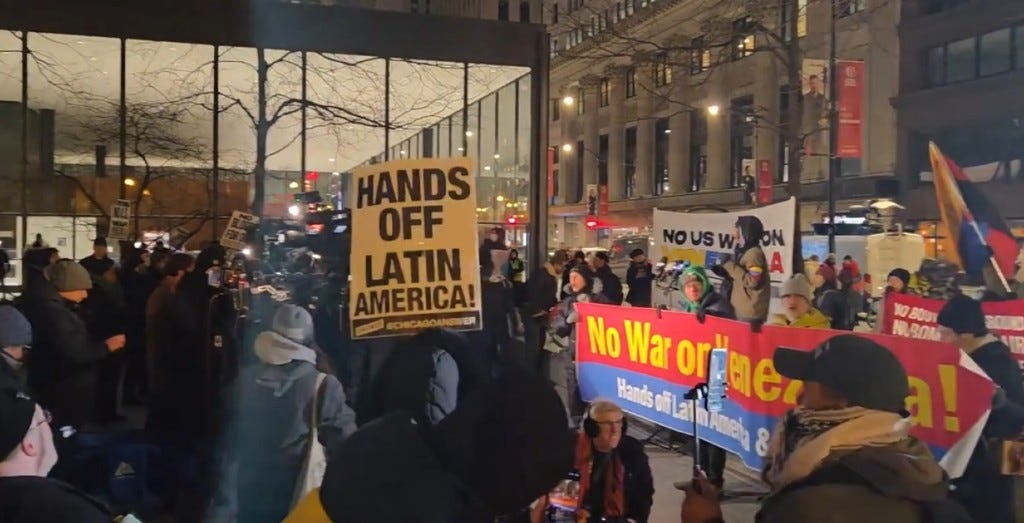
Thousands of Americans took to the streets on Saturday and Sunday, outraged by Donald Trump’s military attack on Venezuela and the abduction of its president, Nicolás Maduro.
The anti-war Answer Coalition, which organized some of the emergency protests, listed over 150 demonstrations in big cities and small towns alike, from New York to Decorah, Iowa.
Protesters chanted “Hands Off Venezuela” and “No Blood for Oil.” They decried the attack as a clear violation of U.S. and international law and an act of imperialism.
In New York City, hundreds gathered in Times Square on Saturday. One protester, Manolo De Los Santos, told the Wall Street Journal: “I feel this country is going back to its worst instincts as an imperialist nation.”
The crowd then marched to Trump Tower on Columbus Circle, amNY.com reported. PIX11 News has video. (A “No War! No Kings!” rally and march starting at Central Park is scheduled for Jan. 11.)
In Chicago, ABC7 News reported on Saturday that “The entirety of Federal Plaza in the Loop was packed with large crowds of protesters pushing back against the Trump administration.”
Chicago journalist Dave Byrnes posted video from the march, which took place in below-freezing temperatures.
In Philadelphia, more than 100 people marched from Philadelphia City Hall to a U.S. Armed Forces recruitment center on Saturday, WHYY reported.
“Congress needs to take back its power,” David Gibson, one of the protest organizers, told WHYY. “They’re supposed to represent the people. We’re the ones who are supposed to decide whether or not to go to war.”
CBS News reported: “Hundreds of demonstrators gathered in downtown Los Angeles on Saturday, where, despite heavy rain, they made sure their voices were heard as they denounced the military action taken in Venezuela overnight.”
In Washington, D.C., hundreds of protesters gathered outside the White House on Saturday and then on Tuesday outside the Kennedy Center, where Trump was speaking to a Republican congressional retreat.
In Grand Rapids, a protest organizer was recorded on camera being arrested immediately after being interviewed by WZZM, a local ABC affiliate. Jessica Plichta, a 22-year-old preschool teacher, organized the rally with Grand Rapids Opponents of War.
“It’s our tax dollars that are also being used to commit these war crimes,” Plichta said in the interview. Then she was arrested.
“When a bystander asked why, an officer said it was for obstructing a roadway and failure to obey a lawful command from a police officer,” WZZM reported.
Plichta was released after several hours in jail, with no charges filed.
OPB News reported from Oregon that more than 200 protesters gathered in Portland, and more than 100 attended a rally in Eugene. Hundreds of protesters briefly stopped traffic in downtown San Francisco. A crowd of protesters formed at Seattle’s waterfront, KOMO News reported. Here’s some video. Protesters also gathered in Sacramento, in Charleston, S.C.
Several resistance groups issued statements opposing the attack.
“Trump’s attack on Venezuela and kidnapping of Maduro is wildly illegal, immoral and irresponsible,” said Leah Greenberg, co-founder of Indivisible. “The power to declare war belongs to Congress and the American people. Trump has once again taken power that’s not his. He is attempting to drag the country into war by decree, all while treating the presidency like a throne. Congress must act immediately to stop these illegal strikes and hold the Trump regime accountable. No Kings, No War.”
The Resistance in 2026
What to expect in the year ahead? A major focus of the resistance will, of course, be the November elections, which could put Democrats in charge of Congress.
And before then, there will be any number of primary campaigns that will help define what exactly the Democrats would do with that power. Specifically: How hard would they fight? Because inside the resistance, there is enormous frustration with the current Democratic leadership.
Meanwhile, the powerful grassroots opposition to Trump’s mass deportation campaign will continue.
But what remains unclear is how many people can the resistance mobilize, how often, and to what effect?
For months now, resistance leaders have been talking about supplementing mass protests with what they call “noncooperation.” That means boycotts, walkouts, maybe even some form of general strike.
And in what could be an indicator of stepped-up activity, the Women’s March and 50501 are calling for a Free America Walkout on January 20, at 2 p.m. local time. “We will walk out of work, school, and commerce because a Free America begins the moment we stop cooperating with fascism,” the organizers write. “Walk out to block the normal routines of power, and make the stakes real.” There’s a mass organizing call on Jan. 13.
Anti-ICE Protests All Over
Watch for more major protests in the Minneapolis area in the coming days. As PBS reports, “The Trump administration has launched what officials describe as the largest federal immigration enforcement operation ever carried out, preparing to deploy as many as 2,000 federal agents and officers to the Minneapolis area for a sweeping crackdown tied in part to allegations of fraud involving Somali residents.”
And news reports Wednesday morning indicated that a federal agent shot and killed a woman who was protesting immigration operations in her car. A witness told MPR News that the agent “reached across the hood of the car and shot her in the face like three, four times,” she said.
Federal agents, who began arriving in the area in early December, were already getting an angry reception there. A march in the heart of south Minneapolis’ immigrant business corridor drew thousands of people on Dec. 20, the Minneapolis Star Tribune reported.
A massive Chicago Tribune review of that city’s experience with immigration enforcement cited the powerful protest movement that ensued:
And so a city came together. Its residents marched down streets and made noise at the sight of federal agents roaming neighborhoods. People came out of their houses to point cameras at attempted apprehensions or heated interactions between agents and citizens. In some moments, they locked arms to block the agents’ vehicles, forming a human chain. In many other instances, locals hustled through their blocks in Revere-esque fashion to give warning: ICE is coming.
These actions often came with a price. There were bruises from pepper balls and fits of sickness, of respiratory stress from the tear gas. But more than that there came to be the shattering of illusions and the loss of an inherent faith that what they witnessed could not happen in America. And that if it did, it certainly couldn’t happen on their street, or right outside their door.
In Florida, as the Guardian reported:
Every Sunday afternoon, convoys of protesters from all over Florida, and others from out of state, descend on the notorious “Alligator Alcatraz” immigration jail in the Everglades to stand vigil for those held inside.
Citizens of Roxbury Township in suburban New Jersey are up in arms after a Washington Post report that DHS wants to repurpose warehouse space there as an immigration detention center. Dozens of protestors filled a town council meeting, voicing their concerns, and about 150 people came out to a protest in sub-freezing temperatures on Jan. 3.
And LULAC, the League of United Latin American Citizens, has put out a call for witnesses to report “federal agents engaged in any illegal or unconstitutional activity including warrantless arrests, excessive force, racial profiling, and targeting of immigrant communities”:
LULAC will review the photos and videos received and, as appropriate, report to the proper oversight agency. Where civil rights violations occur, we will refer to legal counsel for possible legal action.
Recent Action in the Courts
A federal judge in Seattle granted a preliminary injunction blocking the Trump administration’s defunding of Head Start and the enforcing of a ban on diversity, equity, inclusion, and accessibility in the program.
A Washington, D.C., federal judge blocked the Trump administration’s attempts to limit members of Congress from visiting detention facilities operated by ICE.
A federal judge in Rhode Island granted a preliminary injunction temporarily blocking Trump administration attempt to shift funding away from proven solutions to homelessness.
A federal judge in Washington, D.C., ordered the Trump administration to keep funds flowing to the Consumer Financial Protection Bureau.
A federal judge in Albany has dismissed the Trump administration’s challenge to New York State’s “Green Light Law” permitting undocumented immigrants to obtain state-issued standard drivers licenses
Public Citizen has sued the IRS and the Treasury Department over changes to tax credits that discriminate against solar and wind energy projects. The suit says the changes were made “with no reasoned explanation, evidentiary support, or statutory grounding.”
The American Federation of Teachers and a Chicago-area nonprofit have filed a lawsuit challenging the U.S. Department of Education’s decision to terminate $60 million in funding for community schools in the middle of approved, multi-year projects.
Rep. Joyce Beatty has sued Trump and others to stop the renaming of the John F. Kennedy Center for the Performing Arts. She is an ex officio trustee of the Kennedy Center.
How About Those Judges
Politico reports:
Federal judges are increasingly exasperated by the Trump administration’s effort to lock up nearly everyone facing deportation proceedings — a draconian expansion of decades-old policies that hundreds of courts have rejected as illegal or unconstitutional.
More than 300 federal judges, including appointees of every president since Ronald Reagan, have now rebuffed the administration’s six-month-old effort to expand its so-called “mandatory detention” policy, according to a POLITICO analysis of court dockets from across the country. Those judges have ordered immigrants’ release or the opportunity for bond hearings in more than 1,600 cases.
And a Chicago Tribune story revealed “a broader pattern of disconnect between the U.S. Department of Homeland Security’s rhetoric of the dangers to agents during Operation Midway Blitz versus the reality borne out in the federal courts.”
A Tribune analysis found that “time and again, Trump’s DHS claimed horrific abuses at the hands of protesters. Yet time and again, their allegations of abuse did not withstand the scrutiny of judicial review.”
End Notes
“All the Kennedy Center cancellations since Trump’s name was added,” from the Washington Post.
Rachel Maddow draws a parallel between Trump’s plans for incarcerating immigrants in camps and the incarceration of Japanese-Americans during World War II -- but this time Americans are speaking out and standing up.
One Illinois couple’s “New Year’s Trump resistance resolutions.”
Stopice.net has launched a Stop ICE Plate Tracker, the first national website dedicated to documenting ICE license plates.
And in case you missed it, New York Times columnist Michelle Goldberg wrote on Dec. 26 that “Trump Is Getting Weaker, and the Resistance Is Getting Stronger.”
Dan, you seem to have forgotten some of the biggest protests: Venezuelan immigrants who were exuberant Maduro had been arrested.