


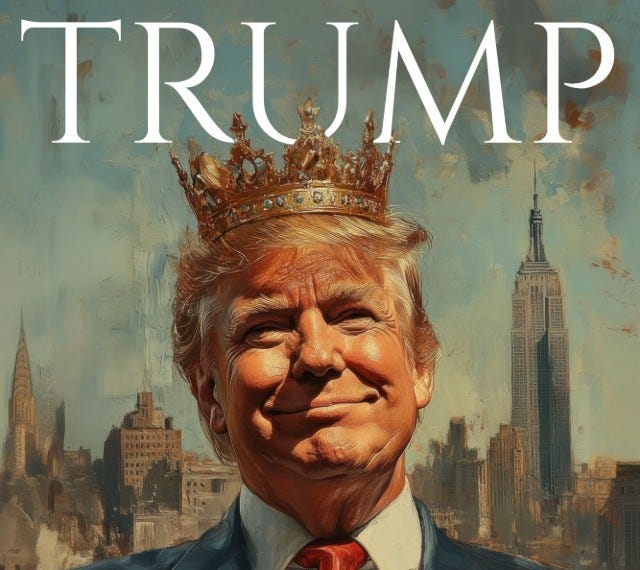
July Fourth – Independence Day – is the original, organic “No Kings” day. It celebrates the rejection of the tyrannical reign of King George in favor of a government that derives its just powers from the consent of the governed.
And the 250th anniversary of the signing of the Declaration of Independence should have been a heck of a party.
But for many of us, it’s impossible to celebrate this anniversary when it’s been coopted by a president who acts like a monarch and keeps being granted more monarchical powers – seemingly every day – by a fanatical Supreme Court and a subservient Congress.
Supreme Court Justice Sonia Sotomayor said it clearly this week, in her dissent to the decision by her six extremist colleagues to give Trump absolute power over previously independent regulatory agencies established by Congress.
“The Court,” Sotomayor wrote, “gives the President a power unknown even to the English Crown against which the Founders revolted, elevating him above his once coequal branches by transforming a duty to take care that the laws be faithfully executed into a license to act in defiance of those very laws.”
Anne Applebaum wrote in the Atlantic that “the Trump administration has destroyed the nation’s 250th-anniversary celebrations,” and that as a result, “Many people who might have participated will not attend, pay attention, or care.”
Paul Starr, writing in the American Prospect, saw a silver lining of sorts:
This is the worst year—and a perfect time—to commemorate the American Revolution. The 250th anniversary of the Declaration of Independence is arriving at a political moment wholly inconsistent with the Declaration itself. Our own leader is a would-be king, responsible for “a long train of abuses and usurpations, pursuing invariably the same Object,” namely his own power and glory, which he confuses with the nation’s.
The message Starr took from this moment is that “America still has work to do to make good on its founding promise.” Trump’s “return to rule by proclamation and prerogative, the very thing America’s founders abhorred and tried to prevent through constitutional restraints” makes that work more urgent, he wrote. “This year’s anniversary ought to reawaken that foundational opposition to arbitrary, personal rule, slumbering in the hearts of the president’s supporters.”
November Becomes Even More Important
Winning the House back from supine Republicans in the November midterm elections has been the top priority of the resistance for many months now. But a whole series of destructive (and racist) Supreme Court decisions has made taking the Senate feel more like a necessity as well – if nothing else to prevent Trump from appointing any more extremists to the high court. And polls show that a Democratic takeover is not impossible.
Just in the past week – in addition to its independent agencies decision – the high court has given Trump the authority to deport over 350,000 legal immigrants – most of them Haitian – back to their home country, despite Trump’s obvious racial animus. It allowed Trump to turn back asylum seekers at ports of entry, a violation of domestic and international law. It threw out a law that guarded against the corrupting effect of large campaign contributions flowing through party committees to candidates.
It could barely even bring itself to affirm birthright citizenship, which is explicitly guaranteed by the 14th Amendment. It barely held that mail-in ballots don’t need to be received by Election Day in order to be counted.
Indeed, expanding the high court to marginalize its six racist, corrupt, and pro-monarchical members is also increasingly seen as an imperative for the next administration.
In the Lower Courts, More Resistance
A federal appeals court panel rejected the Department of Justice’s attempt to force Michigan to turn over its voter rolls as part of Trump’s effort to disenfranchise as many voters as possible. This comes after district court judges in 11 states had ruled the same way. Judge Andre Mathis wrote that when Title III of the Civil Rights Act of 1960 was enacted, “the government used this power to ensure that everyone who had the right to vote could freely exercise that right. But today, the government invokes Title III for an inverse purpose – to ensure that some people have not voted.”
It was a federal district court judge in New Hampshire who issued that 11th ruling against DOJ. Judge Joseph N. Laplante wrote that “DOJ’s demand did not contain a sufficiently stated basis and purpose as required to constitute a valid request, and that “the absence of any basis is independently fatal to the United States’ claim and provides an independent ground for dismissal.”
A federal judge in Massachusetts voided key sections of Trump’s executive order attempting to seize control of voting from the states. Judge Indira Talwani ruled against a centralized lists of adult citizens, writing that “Congress, consistent with the Constitution, has left that authority to the States alone.” She also ruled against the U.S. Postal Service determining who can vote by mail. “No law enacted by Congress delegates authority to control mail-in voting to USPS,” she wrote.
Another federal judge in Massachusetts permanently voided the other key sections of that same executive order – the ones requiring proof of citizenship to register to vote and disqualifying ballots received after Election Day. Judge Denise Casper wrote that she had seen “no evidence” of widespread illegal voting. By contrast, she found a “substantial risk” that citizens would be disenfranchised.
A federal judge in Washington once again ruled in favor of the New York Times in its ongoing First Amendment fight against the Department of Defense’s attempts to curtail press coverage at the Pentagon. Judge Paul L. Friedman initially enjoined the Pentagon from enforcing a new policy that banished real journalists from a Pentagon workspace in favor of those “willing to publish only stories that are favorable to or spoon-fed by department leadership.” He later ruled that the Pentagon violated his order when it responded by banishing everyone. He has now ruled against an “escort requirement,” writing that DOD is no longer entitled to a “presumption of regularity” and was illegally retaliating against the Times.
Two different federal judges struck down a Trump administration rule that would have let the Education Department deny public servants the benefits of a student-loan-forgiveness program if their employers were engaged in such activities as assisting undocumented immigrants, providing gender transition care for minors, or engaging in diversity, equity and inclusion. Judge Myong J. Joun in Massachusetts vacated the rule, calling it “arbitrary and capricious” and in violation of the First Amendment. Judge Amir H. Ali in Washington also vacated the rule, citing some “pretty tortured statutory analysis” by the government.
A federal judge in New York permanently prohibited the Trump administration from withholding funding for the $16 billion rail tunnel under the Hudson River. Judge Jeannette A. Vargas noted that the Trump administration did “not dispute that the suspension of federal grants flagrantly violates federal law,” but rather argued that the court lacked jurisdiction. She disagreed.
A federal judge in New Jersey threw out a DOJ lawsuit against four “sanctuary” cities – Newark, Jersey City, Paterson, and Hoboken – for limiting assistance with federal civil immigration enforcement. Judge Evelyn Padin pointed out that the policies in question also existed at the state level and had been previously been upheld by the Third Circuit.
Prairieland Reaction – and Another Draconian Prison Sentence
I wrote last week about how two conservative federal judges in Texas sentenced eight anti-ICE protesters to a combined 450 years in prison – a staggering amount of time. One defendant shot a police officer outside the Prairieland Detention Center in Alvarado, Texas. But several of the people sentenced to decades in prison were not remotely involved in the shooting, and one defendant, who wasn’t even at the protest, was sentenced to 30 years in federal prison for transporting a box of zines, or political pamphlets.
Federal prosecutors alleged that they were members of an “antifa cell.”
Melissa Gira Grant, writing in the New Republic, called the sentences “a national emergency” and wrote “they are also a warning. This is not the last time the Trump administration will try to severely punish dissent. Opposing these sentences could help us stop the next one.”
Kim Wehle writes for Zeteo: “This is part of an increasingly disturbing pattern of the Trump administration criminalizing speech and assembly in the United States. And it should alarm us all.”
Lex McMenamin writes in the Guardian: “The federal government’s focus on the possession of leftwing literature, including zines, and other basic security measures common in our modern era – like owning Faraday bags, meant to block wireless signals to prevent surveillance; using the encrypted messaging app Signal; or dressing in all-black clothing – is alarming to activists.”
David Graham writes for the Atlantic:
The trial and sentences raise uncomfortable questions about protesting, political violence, speech, and equality under the law—especially when compared with the punishments meted out for those who fomented and participated in the riot at the U.S. Capitol on January 6, 2021, and the subsequent clemency granted to them.
Now a ninth person has been sentenced to decades in prison. KERA News reports that Ines Soto was sentenced today to 50 years. He was convicted of “rioting, providing material support to terrorism, conspiracy to use and carry explosives, and the use and carry of explosives — in this case, fireworks.”
Soto was involved in Signal group chats planning what was intended simply to be a noisy demonstration. He and two others “ran the Emma Goldman Book Club, where members shared anarchist and socialist literature in the form of zines or homemade booklets,” KERA reports.
Six other defendants who pled guilty were also sentenced today to as long as 15 years in prison, the Dallas Morning News reports.
Counter-Programming Trump’s Failed Events
Trump’s hilariously underattended “Great American State Fair” on the National Mall has been an incredible flop.
The scene was different at the Next250 “All of US” rally near the White House on Saturday, where the Guardian reports that more than a thousand people gathered as “organizers launched their Declaration of Interdependence, an art installation featuring the collective values they believe should define the next 250 years of America’s story.”
Those are:
All people are treated with dignity and respect.
Everybody feels safe in every community.
Access to clean, green spaces is abundant.
Every person who works earns a living wage and benefits that allow families work-life balance.
Marissa J. Lang reported for NPR:
It’s really meant to stand in direct contrast to the ways that we’ve seen the Trump administration honor America’s 250. There was that UFC fight on the White House front lawn a couple weeks ago. Right now on the National Mall, there’s blocks and blocks of this Great American State Fair. There have been military flyovers with B-2 bombers soaring over D.C. And what organizers of today’s protest told me is that all of this emphasis on American might and power and nostalgia kind of misses the point that none of this actually gets at American identity in all of its diversity and complexity.
End Notes:
From the Texas Tribune: “Catholic bishop seeks information on ‘wildly disturbing’ ICE arrest of nun walking to South Texas church.”
From Democracy Fund president Joe Goldman and Protect Democracy executive director Ian Bassin in the Philadelphia Inquirer: “The Trump Justice Dept. has forfeited the benefit of the doubt. Act accordingly.”
From the Guardian: “Anti-ICE organizers shift focus to defend democracy from Trump assault.”
From NPR: “Trump axed a Black history exhibit. Former park rangers are teaching it anyway.”