


The Trump administration took another major step toward criminalizing the resistance on Tuesday when the Justice Department unsealed grave federal criminal charges against 15 people involved in anti-ICE protests during the government’s violent immigration crackdown in Minneapolis this winter.
The 15 were charged with conspiring to impede federal officers, with some facing additional charges such as interstate stalking and assault, based mostly on traditional community organizing tactics around blockades and the tracking of ICE agents. (Well, that and a few dents in an ICE vehicle.)
The “overt acts” of a violent “antifa” conspiracy cited in the indictment mostly consisted of transcripts of group messages on Signal where participants engaged in protected political speech. Homeland Security agents raided the protesters’ homes early Monday morning.
The Justice Department is hardly making a secret of its intent to send a message. Minnesota U.S. Attorney Daniel Rosen announced that the “charges and arrests reflect a broad federal effort to address organized lawless behavior, which seeks to disrupt the execution of federal law, endanger law enforcement, and importantly endanger the very communities that these defendants falsely claim to be protecting.”
But coming amid a slew of other federal prosecutions of protesters (most of which have failed) and after a Trump executive order that redefined opposition to Trump as terrorism, it’s obvious that the real goal is political repression. The Trump administration has resistance activists in its sights and is perverting its law enforcement powers in an attempt to silence them.
Progressive leaders in Minneapolis were quick to condemn the charges. “They represent the latest chapter in a federal operation that has repeatedly divided communities and raised serious questions about civil liberties, transparency and accountability,” Monica Bryon, president of the state teachers union said in statement. She continued:
During Operation Metro Surge, Minnesotans checked on neighbors, helped students, supported families in crisis and delivered food and essential supplies. Those acts of compassion and solidarity are not crimes. They reflect Minnesota values.
Yet while community members face charges, Minnesotans are still waiting for answers and accountability in the deaths of Alex Pretti and Renee Good.
Four Minneapolis City Council members decried the indictment as “an act of political repression meant to intimidate and terrorize the same people who have been caring for our neighbors and keeping our communities safe from violent immigration agents.” They continued:
Trump sent masked secret police to terrorize our community and occupy our city. They were forced out by the overwhelming resistance of neighbors who stared down guns and chemical weapons with nothing but whistles and phones in their hands. Families were torn apart, and our neighbors, Renee Good and Alex Pretti, were gunned down in the street for daring to stand in solidarity, and still Minneapolis refused to back down.
Across the world, Minneapolis residents are seen as heroes for the ways we resisted fascism and took care of our neighbors. Our collective bravery and solidarity exposed the true costs of the Trump administration’s fascist playbook. Now, with the tide of public opinion working against Trump, they are turning to legal retaliation to deflect from their massive failure to improve quality of life for working class people. The retaliatory tactics this administration is using today are frightening– but they are a sign of weakness.
Spencer Ackerman, writing in his “Forever Wars” newsletter, has more on how the indictment is “the latest turn of the ratchet in criminalizing resistance to ICE.” And he notes that “Nowhere in the indictment is there even an account of anyone being hurt as the result of any act by anyone accused.”
U.S. Marshals assaulted Twin Cities protesters
Let’s be clear: When it comes to violence at anti-Trump protests, it is almost exclusively the protesters who are the victims, and the federal agents who ought to be prosecuted (and maybe, someday, will be).
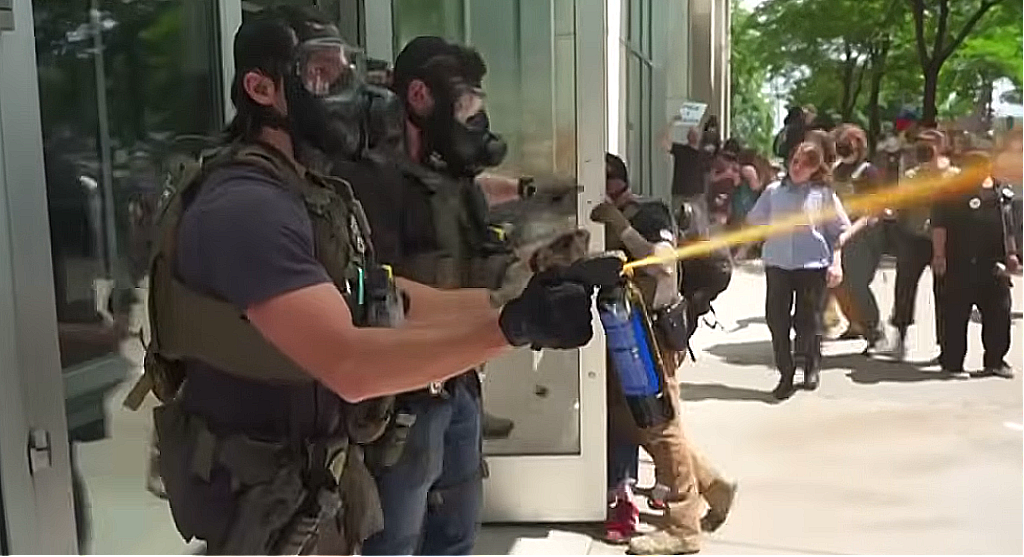
As if to illustrate that very point, U.S. Marshals viciously attacked peaceful protesters who had gathered outside the St. Paul federal courthouse where the indictment was unsealed on Tuesday.
You’ve really got to watch this video. It starts with a young woman politely talking to a U.S. Marshal in the open doorway of the courthouse as several dozen protesters chant anti-ICE slogans outside. Then the marshals attack.
They throw aerosol grenades into the crowd, they shoot pepper spray wildly, they viciously throw one protester to the ground.
Pilar Pedraza reported for KSTP TV:
Witnesses tell me that what was going on at the time is that they were holding the doors open, so that you could hear the chants inside the building, when suddenly somebody saw folks putting on gas masks inside the courthouse. And all of a sudden they came out and started spraying a chemical irritant at them.
Pedraza interviewed the woman in the doorway. “I’m shocked. I’m disgusted,” the protester said. “But more than anything, I am not leaving. I know that they tried to scare us and intimidate us and push us away from solidarity. It’s not going to work. We want justice.”
It’s outrageous. But for people to get outraged, they’d have to hear about it first. In this case, coverage was scant and dismissive. As I’ve written in my Press Watch column, news organizations routinely cover up the one-sided nature of the brutality.
Case in point, the Minnesota Star Tribune simply described it as a “brief struggle between U.S. marshals and protesters.”
The AP published some shocking video, but under the anodyne headline: “Protesters clash with US Marshals in St. Paul, Minnesota.”
Crushing dissent is a White House priority
New evidence of how important squelching protest is to the White House emerged on Monday -- buried in a New York Times article based on a new book by Maggie Haberman and Jonathan Swan. The article was primarily about how administration figures including Stephen Miller have sought to abolish habeas corpus – something we knew already.
The real news was that Vice President JD Vance unsuccessfully pushed to invoke the Insurrection Act in January, just days after federal agents killed Alex Pretti.
He wanted to deploy the military to quell the growing public outcry in Minneapolis.
The authors described a senior White House staff meeting where Vance argued that Trump “needed to invoke the Insurrection Act, swiftly, to crush the unrest in Minnesota.” They wrote: “It would be painful in the short term, he said, but the message it would send — that paid agitators could not get away with disrupting ICE operations — would make sure no one tried it again.” (Of course they’re not paid.)
When a federal case falls apart
The spectacularly failed Justice Department prosecution of the “Broadview Six” anti-ICE protesters in Chicago continues to spawn fascinating developments.
The defendants are now asking Judge April M. Perry to appoint a special counsel to “investigate the misconduct of certain individuals from the U.S. Attorney’s Office for the Northern District of Illinois and, if the evidence supports it, prosecute such individuals for criminal contempt.”
As I wrote last week, transcripts from the grand jury proceedings that resulted in the indictment revealed jaw-dropping abuse of the process by federal prosecutors.
Indeed, the government is so eager to avoid any further discovery that it has informed the defendants that it will not argue against paying their legal fees – even without knowing how much those fees will be.
And Jamie Raskin, the House Judiciary Committee’s top Democrat, is calling for an immediate investigation of U.S. Attorney Andrew Boutros. Raskin wrote in a letter to federal and state officials that “Mr. Boutros’s misconduct has done incalculable damage to public confidence in his office, in the Department of Justice, and in the rule of law.”
Yet more intimidation
More than a hundred federal agents last week raided the offices of Ohio Organizing Collaborative — the state’s leading voter registration group — and “fanned out across the state to interview people who have worked with the collaborative and in some cases seized their electronic devices such as phones and laptops,” the Ohio Capital Journal reported.
The intent was obvious.
“I am deeply concerned that this is an effort to use federal law enforcement to intimidate and halt voter registration and organizing efforts,” Rep. Shontel Brown, who represents Cleveland, said in a statement. “This is an unprecedented attack on democracy,” she said. “Unfortunately, this appears to be part of a systematic effort by Trump and Kash Patel’s FBI to attack our elections and perpetuate more myths of voter fraud – all to undermine and challenge any election result that Trump does not agree with. It’s an attack on the People.”
Michael Waldman, the president of the Brennan Center for Justice, called the raids “troubling” and “outrageous.” He wrote:
This gives every indication of being an extraordinary abuse of power. It is part of a strategy that aims to intimidate voters and those who would help them exercise the franchise.…
What will be produced by this massive display of prosecutorial force? Probably not much of anything but — its progenitors likely hope — dread. If citizens are afraid to register to vote, or to help others register, mission accomplished.
In fact, the strategy seems focused not on enforcing the law but fomenting fear.
Delaney Hall update
There’s almost no media coverage anymore of the continued vigil outside the Delaney Hall immigrant detention center in Newark, now in its 26th day.
Status Coup News, an independent streaming-video outlet, documented more ICE brutality there on Monday night. A small group of protesters were lined up in the parking lot blocking traffic and chanting in support of hunger strikers when dozens of masked and armored federal agents emerged from the gates and attacked them with pepper spray, shoving them, and violently arresting at least one person who appeared peaceful to me.
Something similar happened on Friday night, again via Status Coup News. This time, ICE agents came out in force and immediately deployed pepper spray and pepper balls to push the blockading protesters back.
Meanwhile, there appears to be new activity inside the hall. The Guardian reported last week that nearly 40 women have joined the ongoing hunger and labor strike.
NJ.com cites reports that many of the male strikers have been transferred out of the facility. And it notes that the hunger strikers “are not starving themselves entirely” but rather “are refusing to eat the food provided by the GEO Group, while strictly rationing food they purchase at the Delaney Hall commissary.”
MS NOW’s Antonia Hylton on Tuesday interviewed Marianne Delaney, whose aunt Geraldine is the building’s namesake. It used to be a rehab facility, before the GEO Group turned it into a private detention center.
What would her aunt think about what’s going on now?
“I think Geraldine will be horrified,” Marianne Delaney said. “She was all about recovery and healing and giving people a second chance in life. She saved lives. She spent 50 years working as a pioneer in addiction and alcohol treatment, and she is known and renowned globally for her work.”
She continued: “It was intended as a 250 bed facility, to do good, to save people’s lives. Not to be a warehouse for human despair, which it appears to have turned into.”
Democrats from the House Homeland Security Committee are holding a field hearing in Newark about Delaney Hall this afternoon. In his opening statement, ranking member Bennie G. Thompson of Mississippi decried the Trump administration for launching “the most cruel, inhumane, and unlawful immigration policies in modern history.” He continued:
We have all heard the horrific accounts coming out of Delaney Hall—and many of my colleagues here today have witnessed them firsthand. We’ve seen detainees living in inhumane conditions, mistreatment and abuse by staff, and food contaminated with worms and maggots. These are not isolated incidents. These are symptoms of a system collapsing under secrecy, neglect, profiteering, and disregard for human life. Let me be clear: every person detained in this country — regardless of immigration status — is entitled to basic human dignity.
They are entitled to safe and sanitary shelter, necessary medical care, access to legal counsel, and edible food. These are not luxuries. They are the minimum obligations of a government that detains human beings. Facilities like Delaney Hall are required to meet standards of care. What we have seen and heard makes one thing undeniable: those standards are being violated.
A major new resistance figure
Janeese Lewis George, a democratic socialist and ferocious critic of Trump’s interventions in her city, appears to have won the Democratic nomination for mayor of Washington, D.C. (The November general election is a formality in D.C., given the overwhelmingly Democratic electorate.)
She has promised to be much more resistant to Trump than the current mayor, Muriel Bowser. “Complying in advance has never helped a community, especially one under an authoritarian leadership like the one we are currently experiencing in the White House,” Lewis George has said.
Trump last week threatened a federal takeover of the city if Lewis George won.
She responded: “Threatening Home Rule because you do not like how residents vote is an attack on democracy itself.”
So stay tuned.
In the Courts
A federal judge in Massachusetts ordered the Trump administration to restore information about subjects like slavery and climate change it had removed from displays in national parks. Judge Angel Kelly wrote that “The government’s stewardship of these park sites… carries a responsibility to present history in full rather than in favored fragments. Unfortunately, the Government has disregarded these principles.” She concluded “Not only does this undermine the integrity of the National Parks; it sets a dangerous precedent of censorship and sanitization.”
A federal judge in Maryland struck down Trump administration rules that could have stripped more than a million people of their Affordable Care Act insurance coverage by shrinking sign-up windows and heightening eligibility verification — ostensibly in an effort to reduce fraud. Judge Brendan A. Hurson wrote that “The circular reasoning and conclusory statements offered to justify the policy change are not indicative of reasoned decision-making.”
A coalition including conservation and historic preservation groups has filed suit seeking to protect West Potomac Park, a popular recreational haven near the Mall, from being turned into a “National Garden of American Heroes” featuring statues of 250 people Trump approves of, starting with Christopher Columbus.
End Notes
From the Nation: “Raucous Protest Is Coming to the Joyless World Cup.”
From the Jersey Bee: “Why we’re calling Delaney Hall a ‘concentration camp’.”
From the Washington Post: “Ms. Rachel goes to Washington, carrying letters from children in ICE custody.”