


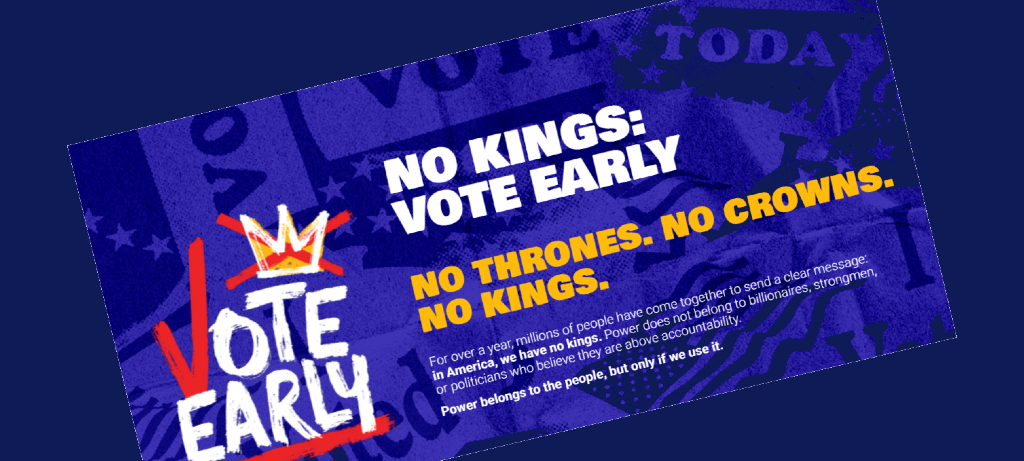
There is, at long last, something concrete anyone and everyone can do to resist Donald Trump.
OK not quite yet, but very soon.
You can learn the rules about registering to vote and casting a ballot in your state.
You can vote early.
You can make sure your friends, neighbors, and low-information voters in your community know what to do – and vote early.
Trump is pursuing a wide variety of ways to restrict voting in November, hoping to rig the elections in favor of Republicans. Marc Elias, writing on his invaluable Democracy Docket website, provides an excellent summary.
And the seemingly endless court fights over Trump’s tactics have left some election officials and voters uncertain about how everything will turn out.
Indeed, a key part of Trump’s strategy is to create chaos and confusion and sow doubt so that he can try to challenge election results he doesn’t like – and potentially try to justify seizing ballots from Democratic precincts, which would effectively invalidate them.
Lawyers from pro-democracy groups are litigating like mad, as I’ve chronicled here over the last several months (including today, see below). They’re also gearing up for court fights on Election Day.
So given all the uncertainty, the more people who vote early the better.
That’s why the next major No Kings event will be a Nationwide Early Voting Day of Action on October 17. There’s a kickoff call tomorrow (Thursday) from 8-9 p.m. EDT.
No Kings coalition partner Public Citizen describes it as “a day of coordinated, nonpartisan action across the country to drive early voting.”
Maybe you left the earlier No Kings events feeling inspired and energized – but didn’t know what to do next? That won’t be an issue this time around. Public Citizen explains:
This No Kings activation will look very different: community events will vary from block parties to rallies to walks to the polls. Each one will be working toward a common goal: making sure every eligible voter has a plan to vote early (where possible), knows their options for how to vote, and is ready to make their voice count by casting their ballot.
Encouraging early voting is also at the heart of the “100 days 1,000 marches” voter-mobilization initiative organized by Bishop William J. Barber II and his Repairers of the Breach organization.
“If your state has early voting: march to the polls, nonviolent and nonpartisan, on day one – and keep marching as much as possible through November 3,” the website says.
Barber says he is aiming to mobilize millions of low wage infrequent voters, “particularly in the South and battleground states, utilizing peer-to-peer text messaging, grassroots phone banking, door-to-door canvassing and more in addition to the marches to the polls.”
“In the last election, 90 million people didn’t vote while the majority in Congress was decided by just 7,000 votes,” Barber said at a news conference in August. “We don’t need to march on Washington right now. All of our money, energy and effort needs to be marching, walking, running and riding to the polls. We must meet this constant and visible attempt to suppress the vote with the most massive voter mobilization we have seen in recent history.”
Almost Everyone Can Vote Early
Here’s a map from the National Conference of State Legislatures showing that there are early voting options in 47 states. Alabama, Mississippi, and New Hampshire are the only three states that have no explicit early voting options – although eligible voters can request and cast absentee ballots.
As the Brennan Center explains, early voting can consist of:
In-person early voting, in which a voter casts a ballot at a polling place ahead of Election Day
In-person absentee voting, through which a voter completes an absentee ballot in a polling place or election office before Election Day
Mail voting, through which a voter receives a ballot by mail and returns it by mail, ballot drop box, or at an election office.
Another wonderful thing you can do is sign up to be a poll worker. The Power the Polls group serves as a national clearinghouse. Or you can use the U.S. Election Assistance Commission’s Poll Worker Recruitment Lookup Tool.
How Much Will Democrats Resist if They Win?
Well, that’s an excellent question.
What can a majority-Democratic Congress practically achieve, given that Trump will retain his veto power and has a history of ignoring congressional budgets and subpoenas?
Nobody’s been asking. Which is why I wrote an opinion piece for MS NOW last week, urging people to start thinking about an aggressive yet pragmatic agenda – one that Democrats, if they flip one or both chambers of Congress, can actually deliver.
“By and large, to enact major legislation, Democrats will have to negotiate with Trump. How do they intend to do that, and what are their top priorities for those negotiations?” I asked.
“What, if anything, is non-negotiable?” I asked (I offered some possibilities). “What are Democrats willing or able to use as leverage?”
I hope to be getting answers to these questions through reporting in the coming months, in some forum. If you have any thoughts, or know someone I should talk to, get in touch.
ICE Agents Beat Up Protesters in Maryland
ICE agents violently attacked protesters in Frederick, Md., on Friday night, after some in a crowd of over 100 people chanted and linked arms, blocking agents from a house they had apparently been staking out.
Video shows agents swinging batons, one of them repeatedly striking a man on the ground.
WBAL-TV reported that protesters suffered cuts and bruises, with some requiring hospitalization.
ICE was “beating people with batons, kicking them, punching them, throwing people on the ground,” Tatiana Santos, who is with Indivisible Frederick Forward, told WBAL.
“It felt like they were just terrorizing people. You don’t get brutal with people. It’s inhumane,” Soolah Kemp told Maryland Matters.
WUSA-TV reported that local Rep. April McClain Delaney is calling for a full investigation.
ICE agents had apparently been active in the neighborhood for several days. “The past week has been crazy. Everybody has been terrified,” one resident told WUSA. “ICE agents started coming in around Monday morning. They were terrifying, wearing masks, pulling down their windows, putting the headlights on for the cars passing by.”
One Bluesky poster described an ICE “siege” of the neighborhood. “Locals rallied. They stood watch as kids got on the bus and were dropped off. They helped escort at-risk neighbors to their jobs and kept track of where ICE had posted up,” the poster said.
“Community members set up on corners in that area, holding signs such as ‘La Migra Esta Aqui’ and ‘No ICE in Our Community’.”
Friday night’s activities apparently began innocently enough: “We then started to have a dance party, bopping around half-heartedly to Madonna’s ‘Vogue’ in front of the house that was now clearly the target.”
A Department of Homeland Security spokesperson refused to answer questions from journalists, but said in a statement that “Under President Trump and Secretary Mullin, if you break the law, you will face the consequences.”
In other protest news:
The CT Mirror reports: “More than a thousand people took to the streets in Danbury on Wednesday night to protest recent immigration arrests that have stunned the community.” There have been more than 100 recent arrests across Connecticut, more than half of them in Danbury, including arrests at school bus stops. I wrote last week about strong objections from the community.
The Colorado Sun reports: “Students from more than 200 Colorado schools streamed out of classrooms Friday afternoon with angry pleas for federal immigration agents to halt raids targeting their classmates, neighbors, coworkers and community members.” Some of the students assaulted a counter-protester.
Over 100 people gathered Saturday to protest an apparent ICE surge in Indianapolis, WFYI public media reports.
In Vermont, WCAX-TV reports that several local clergy members were arrested during a protest at a DHS building in the town of Williston on Friday morning. They blockaded the doors inside the building, refusing to leave and calling for an end to ICE operations there.
The Week in the Courts
In June, Massachusetts District Judge Indira Talwani declared that Trump’s executive order letting the U.S. Postal service decide whose ballots to deliver was unconstitutional. She was overturned by the Supreme Court on the grounds that her order was premature because the USPS hadn’t yet promulgated a final rule when the suit was filed. Then came the final rule. Now, this past week, Talwani again blocked the new rules from taking effect in time for the midterm elections, writing that Trump’s idea “threatens disenfranchisement of millions of United States citizens who seek to vote by mail.” And now Trump has again appealed to the Supreme Court.
The D.C. Circuit Court of Appeals rejected a Trump administration request to pause a lower court ruling that blocked the use of the Systematic Alien Verification Entitlements (SAVE) database for mass voter purges ahead of the midterm elections. “The public interest does not favor interim restoration of a system the government has not made a strong showing it may lawfully operate,” the court wrote. Trump has now appealed that to the Supreme Court as well.
First, the Missouri Supreme Court threw out the new gerrymandered congressional map that state Republicans had designed specifically to squeeze out a Black Democrats, ruling that redistricting was automatically suspended by a citizen petition demanding a statewide vote. Trump’s appeal to the Supreme Court was summarily rejected. So it was back to the old map. But then federal District Judge Stephen R. Clark, in a different case, ordered the state to use the new map because it had already been used for primary voting. And the Missouri Supreme Court is threatening to hold the secretary of state in contempt for not honoring its order. It’s chaos.
The D.C. Circuit Court of Appeals upheld a lower court order preventing the IRS from disclosing massive amounts of sensitive personal data to ICE. “After the Watergate scandal exposed executive branch abuses of U.S. taxpayers’ information to harass the Administration’s enemies, Congress enacted a prohibition against the Internal Revenue Service sharing tax return information with any other federal agency unless the requesting agency meets stringent conditions,” the court wrote. It also called one of the government’s counter-arguments “weak sauce.”
A Maryland federal judge has blocked Trump’s latest attempt to limit birthright citizenship. U.S. District Judge Deborah L. Boardman wrote that Trump’s executive order targeting so-called birth tourism “is almost certainly unconstitutional as applied to the certified class for the simple reason that the Supreme Court in Barbara already decided that the children in the class are citizens at birth.” She wrote: “No Presidential Executive Order can undo what the Supreme Court has done.”
The Department of Justice indicted ICE agent Christian Castro for lying to investigators after a video disproved his viral story about being brutally attacked by an immigrant wielding a snow shovel and a broom in Minneapolis in February. But the more telling fact is that Castro was not indicted on a much more serious criminal civil rights charge -- deprivation of rights under color of law -- for shooting through a closed front door and injuring one of the people inside. Local AUSA Matthew Evans told lawyers for the victims that he was blocked from seeking those charges by senior Justice officials. So the massive cover-up of ICE crimes continues. And poor Evans was fired and possibly faces obstruction of justice charges for leaking the truth.
Welcome to the Resistance
MS NOW’s Jen Psaki welcomes MapQuest to the resistance, for not changing Lake Ontario’s name on its maps, like Apple and Google did.
While where I live has an excellent voting system, I’m going to watch to be sure I receive my mail-in ballot when I should. And if I don’t receive it early, I’ll vote in person right away. I realize not everyone can do vote in person, but I can and will. Evidently, like trump, who always votes by mail.