


Donald Trump’s demented threats against Iran, amidst his utter debacle in the Middle East, have suddenly accelerated the resistance view that the most important and urgent question in the world is how to remove him from power.
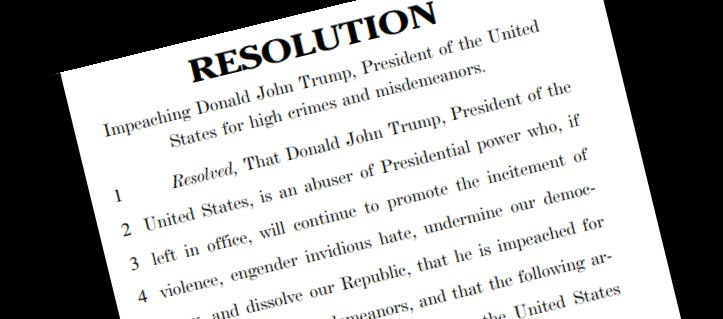
Calls for his impeachment and removal — or the application of the 25th Amendment — are growing louder in the political discourse.
Such steps remain well out of reach politically, given the Republican party’s control of Congress and continued subservience to Trump’s will. But some fractures in the MAGA coalition are appearing.
And the more we talk about it, the more possible it gets. So listen:
Sen. Ed Markey: “25th amendment. Impeachment. I will support any avenue to remove Donald Trump from office. We cannot leave this man in charge of America’s nuclear weapons as he threatens to end an entire civilization.”
Rep. Pramila Jayapal: “Donald Trump threatening the destruction of an entire civilization is madness. He is completely unfit to serve as President of the United States. Invoke the 25th Amendment. Or Republicans must stand up with us to impeach him. We cannot allow him to set fire to the world.”
Sen. Ron Wyden: “Donald Trump is deranged. He must be impeached and removed from office. Republicans who don’t stop him will have blood on their hands, and anyone who carries out an order to bomb civilian targets will be complicit in war crimes and will be held accountable.”
Rep. Jamie Raskin: “Donald Trump’s deranged threat to destroy “a whole civilization” in Iran is a threat to commit war crimes and genocide. Republicans in Congress must prevail upon VP Vance, now campaigning for Putin’s puppet Viktor Orban in Hungary, to return to the U.S. and invoke Section 4 of the 25th Amendment.”
Rep. Alexandria Ocasio-Cortez: “This is a threat of genocide and merits removal from office. The President’s mental faculties are collapsing and cannot be trusted. To every individual in the President’s chain of command: You have a duty to refuse illegal orders. That includes carrying out this threat.”
Rep. Ilhan Omar: “Donald Trump must be removed from office for threatening war crimes and genocide. Speaker Johnson: bring the House back into session. Invoking the 25th Amendment and impeachment must be on the table, but Congress should also move on a War Powers resolution to stop Trump.”
Rep. Jasmine Crockett: “We are watching a dangerous and unfit President drag this country toward catastrophe — and Republicans refuse to act. Invoke the 25th Amendment. Do your fucking job.”
Rep. Rashida Tlaib: “After bombing a school and massacring young girls, the war criminal in the White House is threatening genocide. It’s time to invoke the 25th Amendment. This maniac should be removed from office.”
Rep. Ro Khana: “If the United States Congress has any life left in it, every member of Congress and senator must be calling for Trump’s removal today based on the 25th Amendment.”
And it’s not just the usual suspects. Axios reports that “More than 85 House Democrats had called for President Trump to be impeached or removed via the 25th Amendment as of Tuesday evening.”
Back in December, Rep. Al Green’s impeachment resolution failed to advance in December, although 140 Democrats did vote in favor of bringing it to the floor.
Practically speaking, the most promising approach to at least limiting Trump’s power is through the War Powers Resolution, which in theory checks a president’s power to engage in hostilities.
House Democratic leader Hakeem Jeffries told CNN’s Anderson Cooper last night that “a two-week ceasefire is insufficient” and that House Democrats will move for a War Powers vote to end the war as soon as the House is in session next week.
“All we need are a handful of Republicans to join us,” he said.
All he actually needs is for all the Democrats to vote with him. A resolution calling for a pullout from Iran within 30 days nearly passed in early March, 212-219, after two Republicans voted for it but four Democrats voted against it. (Jared Golden of Maine, Greg Landsman of Ohio, Henry Cuellar of Texas, and Juan Vargas of California – any of them belong to you?)
Of course the Senate would need to pass such a resolution as well. It failed to do so in March by a 47-53 margin. And then Trump, who calls it a war but officially says it is not a war, would veto it.
Incidentally, there are at least 60 antiwar protests scheduled for this afternoon across the nation.
Looking to the Midterms
The most surefire way to comprehensively stymie Trump, of course, is for Democrats to win back control of one or both houses of Congress in the elections to be held in 209 days.
Sadly, that will take more than just votes. It will also require fights to protect the vote and to count the vote.
Wired, for instance, just published an ominous article detailing how “Trump and his allies are quite openly engaged in a concerted and widespread effort to undermine trust in elections and, seemingly, to lay the foundations for baseless claims of rigged midterm elections in November.”
Protect Democracy has a comprehensive and scary new report about Trump’s attack on elections titled Executive Override. As Ben Raderstorf writes for the group’s blog, “The report describes a coordinated strategy already underway to spread disinformation and conspiracy theories; tilt the electoral playing field and manipulate election outcomes; and, if necessary, try to overturn unfavorable results.”
Happily, this report also identifies five major roadblocks standing in the administration’s way. “These are the pillars of American democracy that make it much harder to corrupt and steal legislative elections in the United States than it was in Russia, Hungary, or Venezuela,” Raderstorf writes.
As for what you can do? Raderstorf writes:
Counter disinformation. Vote. Help others vote. Strengthen community connections. Volunteer as poll workers. Be prepared to mobilize peacefully if a critical moment demands it….
Democracy only survives if we’re active participants in it — that’s always been true, and it’s never been more urgent than right now.
Brennan Center president Michael Waldman, similarly, writes that “we can now see that Trump and his allies are pursuing five distinct tactics. And for each aggressive move, a countermove is in motion to defend our elections.”
One of the Trump tactic Waldman identifies is the possible use of immigration forces or troops to intimidate voters or disrupt balloting. He writes:
That’s where citizen engagement comes in. Civil society groups are beginning to mobilize: clergy, veterans, and more. The League of Women Voters has announced plans to mobilize tens of thousands of volunteers to poll watch, walk people to the polls, and generally ensure calm and safety for voters. Others are doing the same. The business community can help encourage poll workers. We need a community mobilization like the one we saw in Minneapolis, neighbor helping neighbor, in the event of mischief.
Here’s a website summoning people – especially younger ones – to become poll workers.
What might well be the canonical list of all the things you do to protect the elections was published last year by Marc Elias, the all-star election lawyer who also founded the essential Democracy Docket website.
Educate Yourself
Share What You Learn
Run for Something
Volunteer for a Campaign
Join or Support Pro-Democracy Organizations
Become a Trained Poll Worker
Engage Your Elected Officials
Vote in Every Election
Stay Engaged
Support Independent, Pro-Democracy Media
Victory in Utah
Here’s a grassroots victory to celebrate, in Utah!
For a while it looked like a Republican-led bid to restore the state legislature’s power to gerrymander voting districts had gathered enough signatures to get on the November ballot. (In 2018, Utah voters had voted for a measure that put an independent commission in charge.)
But news broke that signature-gatherers used deceptive tactics to lure people to sign. So a pro-democracy group called Better Boundaries launched a campaign urging voters who had been misled to remove their names from the petitions they had signed.
More than 10,000 Utahns have now removed their names. Ballot rules require a certain threshold of signatures in at least 26 of 29 state senate districts, and in at least one key district the signature-removals were enough to drop the number below the threshold.
In a Democracy Docket video, Better Boundaries executive director Elizabeth Rasmussen celebrated the victory. “We’ve had less money, less institutional power than anyone else,” she said, “but the voters are smart, they know what they want, so just remind them of what they’ve approved and the reasons why and they’ll show up.”
Big Warehouse News
The Associated Press brings us great news:
The Department of Homeland Security is pausing the purchase of new warehouses intended to house immigrants as it scrutinizes all contracts signed under former Homeland Security Secretary Kristi Noem, according to a senior Homeland Security official…
The official also said that warehouse purchases that were already made are also being scrutinized.
Why? At least in part thanks to the resistance:
The plan was hatched during Noem’s tenure but immediately ran into intense opposition around the country by residents and communities opposed to such large Immigration and Customs Enforcement facilities in their neighborhoods.
Many objected on moral grounds to ICE’s presence in their neighborhoods, while others questioned whether the facilities would be a drain on local resources, such as sewer and water systems.
Retrofitting work has stopped at one facility that I know of. The Baltimore Banner reports that ICE is “reconsidering the precise scope” of a massive facility planned for a warehouse in Washington County. In a response to a lawsuit filed by the Maryland Attorney General’s Office, ICE said it will conduct additional environmental analysis before making a final decision on its plan.
The essential Project Saltbox website writes that the political struggle is ongoing:
The Enforcement and Removal Operations arm of ICE — the agency actually tasked with running the facilities — has grown increasingly resistant to the program.
But Stephen Miller, Trump’s Deputy Chief of Staff for Policy and his principal Homeland Security advisor, is pressing hard to keep it alive.
I never bet against Stephen Miller.
Meantime, as Project Saltbox also reports, Democratic lawmakers this week opened an investigation into the private companies helping build the immigration detention network.
This Week in the Courts
A federal judge in California demanded that the Trump administration stop violating a 40-year-old court order protecting the due process rights of unaccompanied immigrant children in government custody. Judge Michael W. Fitzgerald revoked a Trump administration memo that encouraged border officials to coerce children by threatening them with “prolonged” detention and other consequences if they sought to speak with a relative or attorney.
A federal judge in Massachusetts blocked the Department of Education’s demand for seven years of student data from every university, including race, sex, GPA, and test scores on every applicant. Judge F. Dennis Saylor IV wrote that the requirement was promulgated in a “rushed and chaotic manner” in order to meet a Trump deadline, and “epitomizes arbitrary and capricious agency action.”
Trump’s March 31 executive order purporting to govern mail-in voting and create a federal voter database has prompted at least three lawsuits, led by Democratic congressional leaders, the League of Women Voters, and the League of United Latin American citizens. The thing is that the Constitution explicitly states that only Congress and the states can set the rules for elections.
The American Historical Association filed suit challenging a memorandum from the Department of Justice’s Office of Legal Counsel that declared the Presidential Records Act unconstitutional and advised Trump that he “need not further comply with its dictates.” The lawsuit argues that the memo defies binding Supreme Court precedent and asserts “by fiat” that Trump “is legally free to destroy records of his official government conduct, or even spirit away the records for his own future personal use.”
Concentration Camps Around the World
Author Andrea Pitzer writes in her newsletter about the Trump administration’s creation of an international network of concentration camps – and what you can do about it.
“People worried about America pushing concentration camp–style detention overseas might feel particularly helpless, not knowing how to take action,” she writes. “But there are still things that can be done.” Such as:
Try to address the harm at earlier stages. So one way to keep those detained from being deported to a third country—and perhaps deported at all—is to make sure they have legal representation. Few things are as critical as this. Groups like the National Immigrant Justice Center, which works in the Midwest, exist all over the country, and help to make sure that detainees get lawyers….
[S]upport journalism that does reporting about detention and deportation of immigrants. ProPublica has been doing an extraordinary job of late, and independent journalists like Gillian Brockell have newsletters tracking different aspects of ICE movement and operations….
Visit the Third Country Deportation Watch website, and follow the stories uncovered so far. Tie these faraway places to the warehouse conversions happening here at home, and declare that the U.S. should not be in the business of running or creating concentration camps anywhere on the planet.
End Notes
From the Philadelphia Inquirer: “These Philly groups protest Trump and ICE with song, continuing the tradition of music as resistance.”
Charles Sennott, co-founder of Report for America, writes in his newsletter with one example of how “Independent local media lifts voices of resistance to the Trump administration.”
An in honor of Tax Day, this article from the New York Times seems to imply that withholding a symbolic amount of your taxes as a protest won’t get you in trouble. At least not big trouble.
Everything he's done has been unprecedented. Invoke the 25th amendment! Even if it is unprecedented!
Excellent ! Impeachment!