


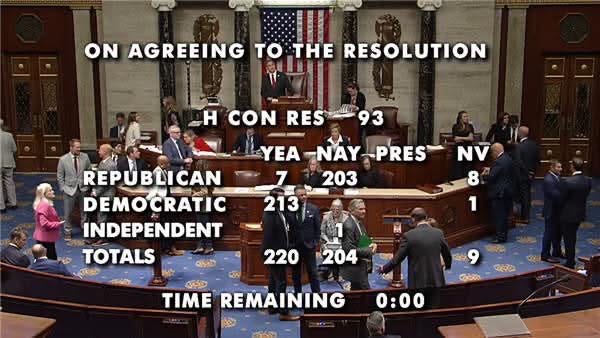
The U.S. House voted to end the war in Iran late last night, for a third time.
“The American people have made abundantly clear they do not support this war,” Rep. Gregory W. Meeks, the top Democrat on the House Foreign Affairs Committee said during the floor debate.
“This Congress has not authorized a war with Iran. And yet this administration has kept our troops in harm’s way, without a declaration of war, without an authorization from Congress, and without any plan for how to win or end the war,” Meeks added.
“Tonight, Congress did its job under the Constitution and said enough is enough,” Rep. Seth Moulton said after his war powers resolution passed by a 220-204 vote, with a record seven Republicans joining all the Democrats.
“People at home are hurting because of skyrocketing costs, and our troops’ lives are in danger in a war that never should have happened,” Moulton said. “We will keep the pressure up until Trump folds.”
Meeks is right that this is not a close call for the American people. A stunning three out of four respondents in a recent poll said they disapprove of the way Donald Trump is handling the war.
But it is notable that the House action came in the absence of any sort of large-scale public antiwar protests.
There were a smattering of small protests in the days after the war began, a little over six months ago. Dozens of military veterans and their families committed civil disobedience on Capitol Hill in April. Unitarian and Presbyterian leaders have expressed opposition, along with the Quakers, of course. The third “No Kings” Day in April brought out some “No Wars” chants as well.
But you can’t say there’s been much of an antiwar movement in this country.
Jeremy Varon, a historian at the New School for Social Research and the author of a book on antiwar organizing against the War on Terror, said in a recent interview with the Waging Nonviolence website that Trump seems to get that a large number of U.S. casualties would trigger much greater opposition.
“My fear is that low-intensity conflicts, like in Iran, may grow routine and become background noise in American political life that never quite rile the public to demand their end,” Varon said. “The trick for Trump is to continue waging war without prohibitive costs that would trigger widespread outrage among a disapproving but disaffected public.”
But the war might be a big factor in the midterm elections, Varon said. “Dissatisfaction with the war is one of a number of grievances with Trump -- along with the public corruption, inattention to issues of affordability, vanity projects, et cetera. If Republicans get routed, public opinion experts will have to sift through the data to find out how important the war has been.”
A couple weeks after Trump’s unprovoked attack, Eric Blanc, a professor of labor studies at Rutgers University, speculated in The Nation about why there had not been more protests.
Among his hypotheses was that “Americans Feel Powerless” and that “Trump Is Doing So Many Horrible Things.” Those sound right to me.
Then again, another hypothesis was “People Are Hoping the War Ends Quickly.”
Failed Prosecutions of Protesters Get Quantified
Kudos to the Associated Press and reporters Jaimie Ding and Claire Rush for their article “DOJ went after protesters for felony assault, but juries, judges were unconvinced, AP analysis finds”.
Their number-crunching concluded that DOJ “failed to secure felony convictions against most of the 102 protesters arrested in four major cities last year on charges of assaulting federal authorities -- a record far below the norm in federal assault prosecutions.”
For instance, “All of the dozen cases that made it to trial, mostly in Los Angeles, ended in acquittal, mistrial or dismissal,” they wrote.
But the AP was way too meek in its payload paragraph:
The dismal record has raised questions about rushed investigations and aggressive charging tactics by prosecutors under pressure to show the Trump administration is cracking down on people who assault law enforcement.
That’s pretty bad, but it’s also terribly understated. As readers of Head Up News well know, DOJ keeps on losing these cases because ICE agents lied, the juries knew it, and even the prosecutors knew it.
Under pressure from Washington to intimidate protesters and find evidence of imaginary antifa conspiracies, federal agents have killed, framed, and surveilled innocent people, and federal prosecutors have violated their core principles. That’s what the AP should have said.
In Washington, Federal Agents Are Arresting Black Men for Minor Offenses
The Washington Post profiled Robert Meyers, a member of a watch group in Washington, D.C., that goes around town monitoring what federal agents taking part in Trump’s “D.C. Safe & Beautiful Task Force” are really up to.
It’s a feature article, with a soft-focus headline – “He worked at NASA. Now he tails federal law enforcement on D.C. streets” – but the story Meyers tells makes for disturbing news.
What his group has seen is that the initial flood of ICE and CBP agents last year has made way for FBI and DEA officers, among others. And most of the people the group sees arrested these days are Black men.
Indeed, the Post analyzed arrests during the first year of the federal takeover and found that more than 90 percent were of Black people.
“Meyers and other rapid responders say that the vast majority of those they have witnessed are for low-level misdemeanors, such as driving with expired tags, improperly turning right at a red light or smoking a joint in public,” the Post reported.
“HSI is supposed to be doing child sex trafficking cases, right?” one group member asked the reporters. If they are arresting people for open containers, she said, “the priorities are not straight.”
Another interesting aspect of this is that unlike the National Guard members who have been deployed onto Washington streets, federal agents can make arrests. The media has almost exclusively been paying attention to the National Guard, which does basically nothing. It’s these guys who are on the hunt.
Some news organization has a solid follow-up or two in their future.
The Week in the Courts
What a week it was!
The biggest news, of course, was that the Supreme Court blocked a new Trump rule that would have put the U.S. Postal Service in charge of who gets to vote by mail, which would have caused chaos and mass disenfranchisement.
Very disturbingly, three justices – Clarence Thomas, Samuel Alito, and Brett Kavanaugh – indicated they thought the move was just fine. (Kavanaugh just thought it was too rushed.)
That came after two district-court opinions and one appellate-court opinion, all of which made it clear this wasn’t a close call. (People who say the Supreme Court was taking a bold stand against Trump are grading on a serious curve .)
I wrote about the first district-court opinion last week.
On Thursday, a unanimous panel of the First Circuit Court of Appeals also rejected the mail-in ballot rule, noting that the Elections Clause of the Constitution assigns the regulation of elections “to the States and Congress, and not to an executive agency, such as the Postal Service, acting without congressional authorization.”
The court wrote that the rule would “likely result in the disenfranchisement of millions of voters across the country while providing minimal -- if any -- gains in combating voter fraud.”
What voter fraud? You might well ask. The court didn’t mince words, writing: “there is no record evidence of past fraud or a likelihood of impending fraud related to the November 3 election.”
Then on Sunday, D.C. District Court Judge Carl Nichols ruled that key portions of the new plan “exceed any conception of the outer bounds” of authorities granted to the Postal Service. He noted that “Plaintiffs have proffered substantial (and essentially uncontested) evidence that it will be close to impossible for at least some States to design and reprint Rule-compliant envelopes.” He offered a reminder that the public has a “strong interest in exercising the fundamental political right to vote.” And he mocked DOJ’s attempt to consider regulations for the mailing of cremated remains and replica explosives as a precedent.
In other court news:
The 4th Circuit Court of Appeals became the ninth straight appellate court to reject the Trump-era policy of detaining immigrants without bond even when they have long-term ties to the country and present no danger or flight risk. The court wrote that federal laws and regulations clearly require noncitizens like the two immigrant plaintiffs in the case to “be provided a bond hearing and be eligible for release pending removal.” The 2-1 decision stated that “If we were to agree with the Government’s construction, we would need to conclude that, in passing IIRIRA [the Illegal Immigration Reform and Immigrant Responsibility Act] thirty years ago, Congress intended to direct the single largest mass detention of human beings in our nation’s history.” Two appellate courts have sided with the government. So now it’s up to the Supreme Court.
A panel of the Ninth Circuit Court of appeals vacated a district judge’s criminal conviction of a Mexican man for illegally entering the United States because prosecutors withheld evidence that some of the Border Patrol agents who testified as witnesses took part in a Facebook group that shared jokes about migrant deaths and racist and sexist slurs.
A federal judge in Massachusetts blocked the Trump administration from using a “loyalty question” on federal civil service job applications, calling it “unconstitutional conduct”. The question asked applicants to discuss the significance of one or two Trump initiatives and say how they would implement them. Judge George A. O’Toole, Jr., wrote that the Civil Service Reform Act (one of several post-Nixon reforms) “expressly prohibits employment decisions made on the basis of an employee or candidate’s ‘political affiliation’” and that applicants “would likely suffer First Amendments harms.”
A federal judge in D.C. blocked Trump from putting his name on the Kennedy Center in any way. “Simply put, Defendants cannot install memorials for President Trump or anyone or anything else at the Kennedy Center without Congress’s blessing,” wrote Christopher R. Cooper. (Trump then called Cooper names, closed the center down, and vowed to block any reconstruction until some court overruled Cooper’s decision.)
A federal judge in California ordered DHS to find some way to make amends for its arbitrary and capricious decision to cut Federal Emergency Management Agency staff by 50%. Judge Susan Illston wrote that new staffing levels appeared to be “pulled from thin air,” then applied unreasonably, and in the absence of any “reasoned decisionmaking” about the consequences. She also penalized DHS leaders for intentionally deleting Signal messages relevant to the litigation.
A federal judge in Massachusetts blocked a DHS rule that would have drastically capped the length of visas for international visitors studying or teaching at U.S. colleges and universities and for members of the foreign press. The current system admits these nonimmigrants for the duration of their educational programs, or the duration of their journalistic assignments. Judge F. Dennis Saylor IV wrote that it has resulted “in groundbreaking research in science, medicine, and technology, substantial economic growth, and a host of other benefits, often on a vast scale.” The new cap would be four years for students and 240 days for journalists. Staying longer would require DHS approval, which is “based on limited and vague criteria, and with no possibility of appeal,” Saylor wrote. That would create incredible uncertainty among would-be international students, he wrote. He added that “it is not difficult to imagine how that system might be abused to punish those whose viewpoints or research are disfavored by the officials making the decision — or, indeed, punish disfavored institutions.”
A federal judge in D.C. blocked DHS from taking any further action against David Streever, a New York man who sent a nasty email to ICE acting director Todd Lyons in January, calling him a monstrous human being, likening him to a Nazi, and warning him – accurately, it turned out -- that Trump would turn on him. ICE responded to the email by sending agents to the man’s home and giving him a “WARNING NOTICE” that threatened him with prosecution if he did not “discontinue” his criticism of ICE. Judge Rudolph Contreras ruled that Streever was engaged in protected speech under the First Amendment. “Americans have long voiced their displeasure with their government,” Contreras wrote. “The Declaration of Independence itself is a list of grievances between Americans and the British government. And Americans have not always indulged in the elevated prose of the Declaration.”
New York and 21 other states are suing to block a new DHS rule that would give immigration officials discretion to deny entry or legal permanent residency to immigrants if they use or are deemed likely to need any kind of public benefits such as Medicaid or even school lunches and state-subsidized health insurance. New York City and five other locales filed a similar suit.
Latino civil rights organizations, Common Cause and Denver filed a lawsuit to proactively ban DHS from sending armed federal agents to polling places on Nov. 3. “The specter of armed officers at polling places threatens the freedom of this upcoming election,” they wrote. “U.S. citizens may reasonably fear interactions with ICE. According to available reporting, in recent years, ICE has unlawfully detained more than 170 U.S. citizens. American citizens peacefully exercising their First Amendment rights have been shot and killed by ICE. And ICE agents frequently stop and question citizens — sometimes detaining them for days — based on racial profiling.”
Must Click
From the Washington Post: “The new threat election officials fear: Trump’s federal government”.
From New Jersy 101.5 radio: “Atlantic City Immigrant Group Demands Apology After 6 Arrested at Protests.”
From Nieman Lab: “The Trump administration killed Climate.gov. A new website is resurrecting it”.
From the Guardian: “Trump asked Americans to help him whitewash national parks. They revolted instead”.
From the Boston Globe: “This anti-Trump brigade delivers its message to motorists from on high.”
From Protect Democracy: “What does it take to make a U-turn from authoritarianism?”
From the ACLU: “ACLU Know Your Federal Voting Rights: A Training with Black Voters Matter”, Wednesday, Sept. 16 at 8 PM ET/5 PM PT.
From the International Institute for Democracy and Electoral Assistance, a new report, “The Global State of Democracy 2026,” which has a devastating – but all true – section on how the US “is experiencing a period of marked democratic decline” mostly due to Trump’s “executive aggrandizement.”