


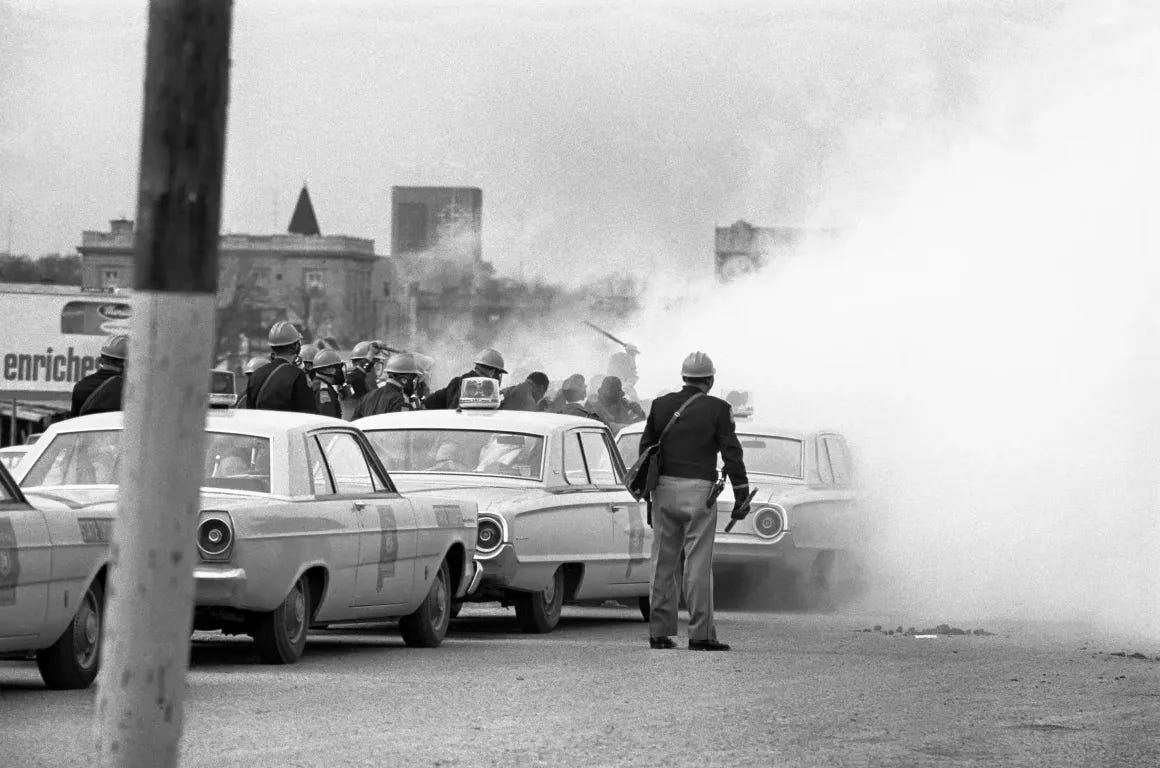
The movement starts Saturday morning in Selma at the Edmund Pettus bridge, where faith leaders will gather at sacred ground and pray.
Then, in the afternoon, outside the Alabama State Capitol in Montgomery, civil rights leaders from across the country will lead an emergency protest – a kickoff for the battle to win back representation for the millions of Black voters the Supreme Court effectively disenfranchised when it gutted the Voting Rights Act on April 29.
It’s being billed as a National Day of Action for Voting Rights.
The website declares: “Same Fight. New Generation.”
But there’s something new about this fight, too. It comes as Donald Trump and the Republican Party are engaged in an authoritarian and white nationalist campaign to hold power regardless of what the people want.
So it’s even more than a battle for civil rights. It’s also a battle for democracy.
It’s simultaneously a battle for minority representation and for majority rule.
And if you’re not fired up to fight white supremacy in the name of American democracy quite yet, you sure as hell will be after you read this extraordinary essay by Sherilyn Ifill, a towering figure in the modern civil rights movement, titled “If You Want Democracy in this Country You Have to Fight White Supremacy.”
I can’t recommend it highly enough. Excerpts do not do it justice, but the core of Ifill’s argument is this:
It was the demand and sacrifice of ordinary people – civil rights lawyers and activists who forced change – many at the cost of their livelihood and their lives whose demands and sacrifices ushered in democracy our country. Once you understand this truth, then you can also understand that the decades-long resistance to the successes of the Civil Rights Movement has always been an anti-democracy movement.
That is why the effort by Trump and Republican state leadership to gerrymander Black representation out of Congress must be understood as not only an attack on Black people, but on democracy itself. If the Republican racial gerrymandering effort is successful, the U.S. will lose any claim to democracy for a generation or more.
And the forces that stand today against citizenship and political representation for Black people won’t stop there. They will not tolerate meaningful political representation for any group that opposes their oligarchical Christian nationalist ideology. They seek a one-party political system in a country ruled by authoritarians. The political oppression of Black people is not the end. It is the conduit.
What’s needed, Ifill writes, is “a strong, determined, even radical Congress,” a reformed Supreme Court, and a cultural reset that reasserts the value of a multiracial nation.
But we can’t get any of those things without power. And our opponents are moving faster than we imagined. We need to accelerate our work. That means that every American who believes in democracy, who believes in equality and humanity must decide now what they can do and what they must do.
Another extraordinary civil rights figure, the Rev. William Barber, made a similar argument on Monday, at a “Moral Monday in DC” rally. You didn’t hear a thing about it, because the legacy media ignored it completely. But Roland Martin’s Black Star Network covered it and captured it on video.
“Democracy is hard,” Barber told the crowd. “But here’s the question before this generation: What do you do when the democracy has been hijacked?” He explained:
You see, we actually have a hijacking that doesn’t believe that America started out broken and has been trying to get better. It believes America was right in its beginning when only wealthy white men were in control, and every effort since then has been a reversal.
His conclusion:
[The] attack on voting rights isn’t just an attack on Black people. It’s an attack on democracy.
See, because the same people that attack voting rights, they want vote power so that they can attack healthcare, so they can attack living wages, so they can attack public education.
And that’s why we have to say no to unholy war. And we have to say no to the violence of voter suppression. We have to say no to all policy violence.
Arguably the biggest question going forward is whether this new attack on democracy will motivate voters in the upcoming elections – and, in House races, will that make up for the advantage that Republicans in the South are now giving themselves by gerrymandering away minority representation?
Responding to the Supreme Court’s decision, the editors of The Nation wrote that the first step is to nominate strong Democrats:
Democratic primary voters need to nominate congressional candidates who are committed to advancing the agenda proposed by Representative Ayanna Pressley, the Massachusetts Democrat who said, “Congress must immediately pass the John Lewis Voting Rights Advancement Act and take action to restore the integrity and legitimacy of [the] Supreme Court—including expanding the court, imposing term limits on Supreme Court justices, and passing a binding Supreme Court code of ethics. Every option should be on the table.
And then, of course, come the November elections, which could not be more pivotal.
Kristen Clarke, general counsel of the NAACP, told MS NOW’s Rachel Maddow on Monday that the outrage will definitely translate into votes. “This election season, you will see turnout like you have never seen before,” she said. “It is at the ballot box where we will use our voice in the most determined fashion during this dark season.”
Could It Be Desperation?
One school of thought rattling around in progressive circles is that the forces of white supremacy and authoritarianism are acting out of desperation, as they see polls showing a supermajority of the public turning against them.
Nicholas Grossman, a political science professor at the University of Illinois, posted this on Bluesky:
The Roberts Court, the Trump White House, and the national GOP are acting like this is their one big shot. Either they secure the lasting end of US Constitutional democracy, or they’re in very serious trouble from the backlash. And they’ve already gone so far that there’s no other possibility.
Writer and organizer Micah Sifry wrote about finding hope in signs that Trump is losing supporters. He concluded:
[T]here’s no question that Trump allies in Congress and many statehouses can see their declining popularity and therefore are pulling out the stops to tilt the playing field further to their advantage. This is making the path to retaking the House much steeper, as G. Elliott Morris points out. It’s also engendering a lot of despair about how the Rs are rigging the game.
But the question I have for you, dear reader, is which trend are you choosing to fixate on? Because believing that all hope is lost is dangerous, and even more so when so many people are doing all they can to turn the tide.
The Great Rift Over the Great Writ
The numbers are staggering: Over 45,000 habeas corpus petitions have flooded federal courts since Trump took office, according to ProPublica’s Habeas Tracker. And it’s all the result of a Trump policy change that judges are overwhelmingly determining was illegal.
How big an increase is that? The TRAC research center, using a different data set, calculated that there were 86 times as many habeas cases filed this past year compared to the previous year.
Why? It used to be that undocumented immigrants who had been in the country for years and weren’t security or flight risks could be released on bond until an immigration court judge determined whether they should be deported or not. Trump’s new policy instead calls for them to be detained, indefinitely, without due process. Their only recourse is a habeas petition.
Back in February, Reuters reported that as many as 400 judges in some 4,400 habeas cases had ruled that the petitioners’ detentions were illegal.
Now Kyle Cheney at Politico is out with his own calculation. He writes:
More than 10,000 times, judges have said those detentions, typically carried out with no opportunity for detainees to plead their case, were illegal. That’s roughly 90 percent of all cases — a staggering rejection of a core piece of Trump’s immigration agenda.
That includes a majority of Trump-appointed judges.
“This isn’t how things are supposed to work in America,” wrote U.S. District Judge Gary Brown, a Trump appointee based in New York, in the case of a man whose lawful status was revoked after ICE arrested him. “Unquestionably, the laws of human decency condemn such villainy.”
Cheney’s article will make you angry. He writes:
These more than 10,000 cases include a nursing mother who was detained despite active refugee status and another mother separated from her one-year-old child and released from custody only when her son landed in the hospital. They include parents of U.S. military servicemembers, trafficking victims or witnesses, a 5-year-old boy detained by ICE on his way home from school.
So why haven’t Trump officials abandoned this clearly illegal policy? Because they are hoping that the Supreme Court will say it’s OK. They are bolstered in this belief by the decisions of two panels of right-wing appellate judges, in the 5th Circuit and 8th Circuit, who ruled in their favor.
But three other circuit panels have now ruled that the policy is illegal. Two of those rulings came in the last week.
In a 6th Circuit ruling on Monday, Judge Eric L. Clay wrote for his divided panel that “Petitioners are more than just names on a pleading.” He continued:
All appear to contribute to their neighborhoods and local communities. Many are the primary breadwinners or essential caregivers for their families, which include their children who were born here and are citizens of the United States.
His conclusion:
[N]oncitizens like Petitioners should have a forum to explain that their backgrounds and connections to their communities justify release on bond while they undergo their removal proceedings. To hold otherwise would subject long-term law-abiding residents in the United States, such as Petitioners, to the hardship of mandatory detention without due process.
In the 11th Circuit ruling issued last Wednesday, Judge Stanley Marcus wrote for his panel:
Simply put, the language that Congress has chosen to use does not grant to the Executive unfettered authority to detain, without the possibility of bond, every unadmitted alien present in the country. Nowhere in the text, structure, or history of the INA [Immigration and Nationality Act] does that reading find steady footing.
Also in Court This Week
A federal court ruled against the second set of global tariffs that Trump imposed — after the Supreme Court overturned his first set. This time around, Trump claimed that a “large and serious balance-of-payments deficits” empowered him to impose a 10 percent surcharge on imports. The court found that Trump was unlawfully redefining the statutory term “balance-of-payments deficits” to mean “trade deficit,” which is an entirely different thing.
In a wildly embarrassing case for the Trump administration, a federal judge in New York ruled that the DOGE Service illegally cancelled $100 million in grants from the National Endowment for the Humanities. Judge Colleen McMahon called it “a textbook example of unconstitutional viewpoint discrimination.” But wait there’s more! DOGE staffers said it was actually ChatGPT that decided what grants were “DEI” and therefore should be cancelled. “The Government,” McMahon wrote, “cannot escape liability for DOGE’s work by scapegoating ChatGPT.”
A federal judge in Washington, in a pair of rulings, enjoined the Federal Trade Commission from pursuing its demand that the two leading medical organizations on transgender health turn over internal documents. Chief Judge James E. Boasberg wrote that the record showed “extensive evidence of animus and wafer-thin justifications lacking evidentiary support.”
The Cultural Landscape Foundation, a nonprofit that encourages good stewardship, is asking a federal judge to halt Trump’s efforts to resurface the Reflecting Pool and paint it blue. “The new coloration will cause the pool to resemble a large swimming pool rather than the reflective civic landscape it was designed to be, distorting the experience of the site for the millions of visitors who come to it each year,” the group wrote.
The Constitutional Accountability Center filed a complaint alleging that Florida’s donation of property worth hundreds of millions of dollars to the Trump library violates the Domestic Emoluments Clause.
‘You Are Winning’
Rachel Maddow devoted much of the top of her MS NOW show on Monday to hailing what she declared was successful pushback to the Trump administration’s plan to establish “a huge new network of some of the largest prison facilities on earth, all specifically designed to hold people without trial and essentially outside the reach of the legal system.”
Over the last few months, I have been acutely interested in this warehouse prison plan that Trump in his wisdom has unveiled. I have been acutely interested specifically in seeing the American people everywhere -- red states and blue states, urban areas, suburban areas, rural areas, everywhere -- have been very interested in seeing the American people step up in all kinds of ways to just say no to this, to say no to building Trump a network of huge new prison camps to fill with whoever he wants.
“I can tell you tonight that if you have been part of the fight against those prison camps,” she said, calling out more than a dozen of them, “I think it’s important to take a moment to know that you are winning. You are winning this. Your pushback has worked.”
She cited an Axios article headlined “ICE targets Plan B after backlash to mega-jails plan.” Then she asked:
Why are they giving up on Plan A? Why are they giving up on the Trump prison camp warehouse idea? Because people have pushed back hard against it. And when people push back against them, generally speaking, they cave.
There are still fights ahead, as Maddow noted, including against an existing ICE facility near State College, Pennsylvania called the Moshannon Valley Processing Center. (Penn Live and Penn State University have just launched a series of stories about Moshannon and the protests there.)
And this just in: Alligator Alcatraz, the notorious jerry-built detention center in Florida, is closing down. CBS News reports that companies hired by the state of Florida to operate the center “were notified Tuesday afternoon that the facility is being shut down, with the remaining 1,400 detainees expected to be removed in the coming weeks.” As the Daytona Beach News-Journal chronicled in video, each Sunday for more than 40 weeks, 75 to 200 people have gathered outside the Florida center to protest.
Also, Project Salt Box reports that “Federal immigration officials and the State of New Jersey reached a temporary agreement Tuesday that pauses major conversion work at a proposed ICE detention warehouse in Roxbury while the government completes additional environmental review, avoiding a scheduled federal court hearing over the project.”
Not all the news is good, though. The American Prospect reports that ICE “wants to expand its concentration camp network in California with a dilapidated Bay Area prison known as the ‘Rape Club.’” That’s on account of its “lengthy history of unchecked sexual abuse.” Critics say the buildings are “falling to pieces and heavily contaminated with toxic waste.”
The Way Forward?
The American Immigration Council is out with a white paper called “Restoring Credibility and Humanity: A New Framework for Immigration Enforcement.”
It’s so different from what we have now:
Built around four pillars—compliance, safety, proportionality, and accountability—it recommends fourteen areas of reform. The plan emphasizes making rules that people living in the country can follow; law enforcement that protects communities from threats rather than treating the community as one; consequences for civil immigration violations that are “tailored, reasonable, and humane”; and holding agencies—and individual agents—accountable, up to and including by firing those who abuse their power.
End Notes
The New York Times reports: “New York Bars ICE Agents From Wearing Masks in Broad Immigration Deal.”
Political consultant Mujtaba Rahman writes in the Guardian that Trump’s “ever-more erratic” behavior is leading Europe’s leaders “to publicly confront the Trump administration on issues ranging from Iran to Ukraine and European sovereignty.”
Author Saul Austerlitz asks in the Guardian: “How do we get more men to join the anti-Trump resistance?”
Never-Trumper columnist Mona Charen writes in The Bulwark that Trump’s corruption is so wildly excessive that “we may, at long last, be passing out of the ‘LOL nothing matters’ phase of this travesty. There is good reason to believe that, finally, Trump’s unprecedented corruption is going to bite him in the ass.”
Sorry Dan but the constitution doesn't guarantee racial quotas be baked into congress.
Things have to get worse before they get better. MAGA might be like the black plague that broke up feudalism in Europe,
will break up undue corporate power. But just how much suffering will MAGA supporters endure before they begin to connect the dots? This is a test of democracy.