


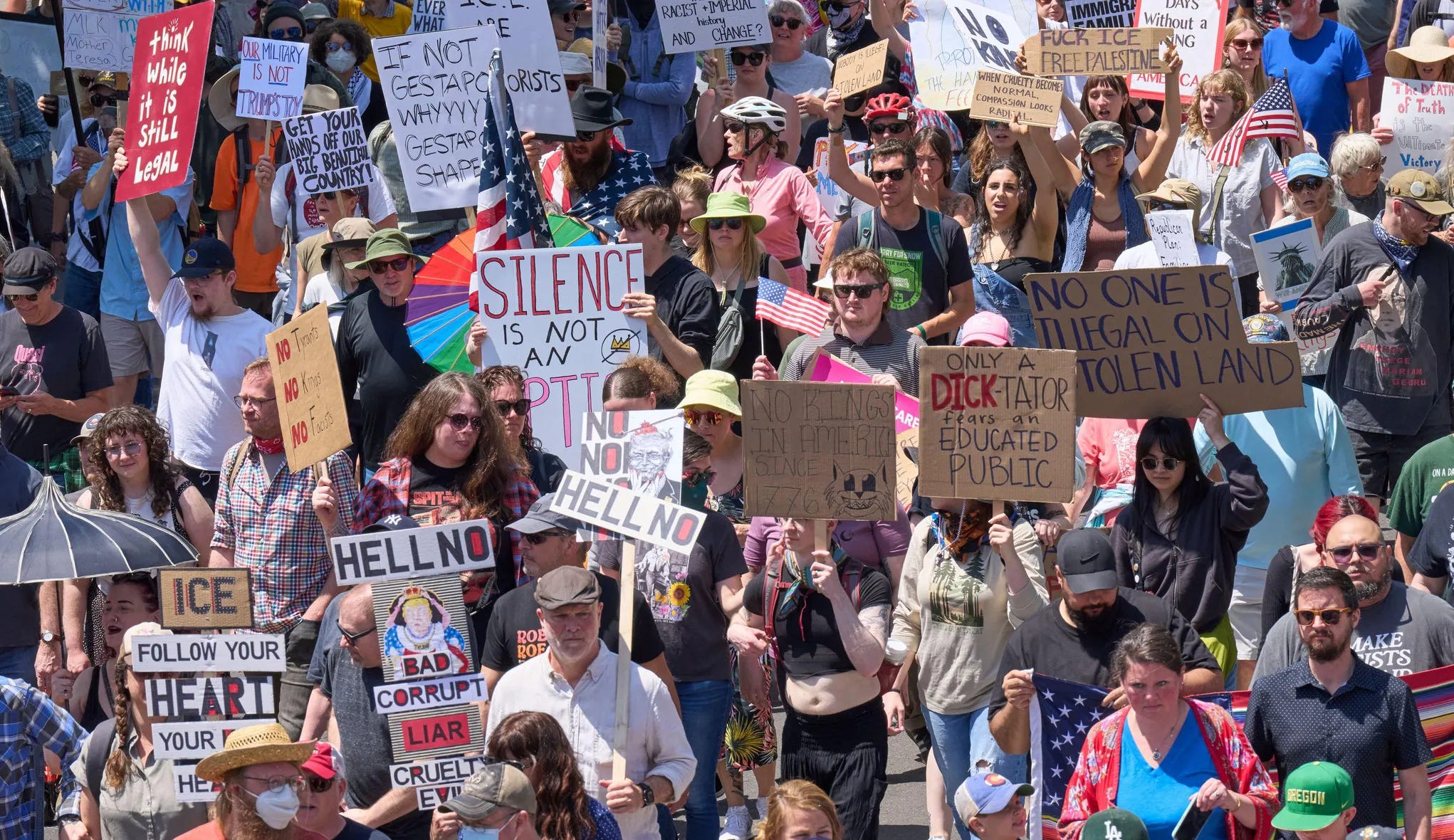
Organizers estimated that about five million people attended the first No Kings Day events on June 14 of last year, and about seven million came out for No Kings 2 on October 18.
With 10 days to go until No Kings 3 on March 28, organizers are expecting the biggest turnout yet – nine million people, or maybe more. That would make it the largest single-day protest in recent American history.
That’s getting closer and closer to what’s widely considered the magic number: 12 million protesters, or 3.5 percent of the U.S. population. A study of hundreds of 20th-century movements found that, as a general rule, no government can withstand a challenge of 3.5 percent of its population without either accommodating the movement or falling apart.
“We are firing on all cylinders to build toward 3.5% on March 28,” Moveon leaders said in a fundraising email.
But success won’t only be measured by the number of people who show up. It will also be measured by the number of people newly recruited to the resistance, and the extent of protesters’ commitment to continued nonviolent action through local organizing committees.
Local action will be key in the coming months, especially as Donald Trump tries to steal the midterm elections, organizers say.
“It won’t be successful if it’s just Saturday and we all go home,” Ezra Levin, co-founder of Indivisible, said in an interview with Wajahat Ali on the Left Hook podcast.
“When he tries to sabotage the midterm election we’re going to have to do a lot more than just show up on a Saturday,” Levin said. “We’re going to have to organize and push back with massive nonviolent pressure akin to what we saw in the Twin Cities.”
The most essential purpose of No Kings 3, he said, is “to grow our ranks.”
The flagship rally on March 28 will be held in Minneapolis. But there will be protests almost everywhere. There are already over 3,000 individual events scheduled. (Find one near you.)
Just for example, there are going to be more than 40 protests in Connecticut alone, 12 in the Houston area, five in the East End of Long Island, and 60 across Oregon.
There will be rallies, marches, festivals, and bridge brigades. People in the Tucson area will be staging an eight-mile “corridor of democracy.”
The ACLU will lead an online training about the Constitutional right to peacefully protest and about best practices for reducing risks when attending protests, at 8 p.m. ET tonight.
And there’s a No Kings “Kickoff call” tomorrow (Thursday) at 8 p.m. ET.
What About the War?
One big question hanging over No Kings 3 is how much of an impact the U.S. war on Iran will have on the protesting. It may be a huge factor. Earlier this week Indivisible posted a social media call linking No Kings with an antiwar message: “No wars of aggression. No terrorizing our communities or yours. No tyrants, no conquests, no kings.”
The war also has the potential to expand the anti-Trump resistance to include former MAGA followers who feel betrayed by the mockery Trump has made of his anti-war campaign rhetoric.
So far, protests against the war have been muted. An essay in the Nation by Rutgers professor Eric Blanc explored why. He identified several possible factors including:
Americans Feel Powerless
People Are Hoping the War Ends Quickly
Trump Is Doing So Many Horrible Things
No Draft
But he suggested that No Kings 3 – and Mayday Strong events planned for May 1 – could enliven an anti-war movement. He wrote:
Most immediately, each of us—and each of the organizations we belong to—can commit not only to attending the March 28 No Kings demonstrations but to going all in to reach out to our neighbors, coworkers, fellow students, and co-congregants to join as well.
The Legal Resistance Strikes Again and Again
You could well be excused for concluding that the Trump administration is just one big criminal enterprise, based on the seemingly endless string of court rulings that his major initiatives are illegal.
Among that latest major legal blows:
A federal judge in Massachusetts temporarily blocked HHS Secretary Robert F. Kennedy Jr. from making radical changes to the childhood immunization schedule and restricting access to COVID-19 vaccines. “There is a method to how these decisions historically have been made – a method scientific in nature and codified into law through procedural requirements,” Judge Brian E. Murphy wrote. “Unfortunately, the Government has disregarded those methods and thereby undermined the integrity of its actions.”
The chief judge on the U.S. District Court for Washington, D.C., quashed the Justice Department’s subpoenas targeting Federal Reserve Chair Jerome Powell. “A mountain of evidence suggests that the Government served these subpoenas on the Board to pressure its Chair into voting for lower interest rates or resigning,” Judge James E. Boasberg wrote. “On the other side of the scale, the Government has produced essentially zero evidence to suspect Chair Powell of a crime; indeed, its justifications are so thin and unsubstantiated that the Court can only conclude that they are pretextual.”
A federal judge in Washington, D.C., ordered the parent agency of the Voice of America to reinstate more than 1,000 Voice of America employees who were put on leave a year ago as part of the administration’s efforts to dismantle the agency. “The Court can hardly imagine the defendants have a non-arbitrary justification for these actions,” Judge Royce C. Lamberth wrote.
A federal judge in Illinois temporarily blocked the Trump administration from pulling back $600 million in public health funds from four blue states. Judge Manish S. Shaw ruled that the administration’s AI-generated explanation for the cuts was not credible, and that the states were illegally targeted at “states with sanctuary jurisdictions.”
A federal judge in Massachusetts indefinitely paused the termination of Temporary Protected Status for more than 1,000 Somali immigrants who would have faced deportation otherwise. DHS wanted their status revoked as of today. These immigrants entered the country legally under the program that offers refuge for nationals of designated countries that are confronting such things as ongoing armed conflict or environmental disaster. Judge Allison D. Burrough’s ruling was procedural, intended to allow time for briefings and deliberation.
A federal judge in Rhode Island ordered the Department of Veterans Affairs to reinstate a union contract covering 320,000 VA employees. Judge Melissa R. DuBose wrote that the termination of the contract “seems substantially motivated by the Plaintiffs’ history and frequency of vocally opposing changes to labor policies” and therefore qualifies as a First Amendment retaliation claim.
A federal judge in Maryland temporarily blocked construction work on an immigration detention center that the DHS had planned to begin operating in an empty Washington County warehouse next month. Judge Brendan A. Hurson cited concerns about the facility’s potential environmental impacts.
Federal prosecutors in Chicago dropped criminal conspiracy charges against two members of the “Broadview Six” – the six people arrested after protesting outside ICE’s Broadview detention center in September. Lawyers for the remaining four members, who have complained of “improper influence” on the prosecution from federal officials, want the charged dropped against them, too.
These lawsuits don’t just vindicate our rights, they bring essential information to light. Case in point, I wrote two weeks about the federal judge in Oregon who barred ICE from conducting warrantless “dragnets” in the state. Sam Levin of the Guardian writes that ICE officers who were compelled to answer questions about their conduct under oath during the trial revealed that they “used a custom-made app to identify neighborhoods and people to target, and had daily arrest quotas they sought to meet during operations.”
What Up With ICE Warehouses?
I already mentioned the federal court ruling that temporarily blocked construction work on a Maryland warehouse that ICE intends to use as an immigration detention center. That case was filed by Maryland Attorney General Anthony Brown.
The city government of Social Circle, Georgia, where residents have loudly opposed the transformation of a local warehouse into a massive ICE detention center, has cut off water and sewer services to the building.
DLR Group, one of the largest architecture firms in the world, will no longer do any work for ICE detention or deportation facilities, the CEO announced after an outcry from employees, Mother Jones reports.
And now Congress may weigh in. NOTUS reports that “Senators from both parties are hoping that the Department of Homeland Security’s approach to acquiring and converting warehouses into large-scale detention centers will change under new leadership.”
Resistance Hero: Joaquin Castro
The New York Times published a gripping article about Texas congressman Joaquin Castro and his continued efforts to free families from the Dilley Immigration Processing Center – the “sprawling prison fashioned out of trailers, which serves as the country’s largest family immigration detention site.”
Dilley “has become a symbol of the indiscriminate nature of the administration’s crackdown,” Annie Karni wrote. “And Mr. Castro, a seven-term Democrat from San Antonio, is on a crusade to close it.”
Castro “has been highlighting the plight of its most sympathetic detainees in a bid to shame immigration authorities into releasing them — and in the process, calling attention to the cruel consequences of the president’s immigration agenda.”
I was wrong about the date, it was MAY 28. I got my info from an incorrect source. I guess I am a poor historian, sorry! Once you get to be 86, life is just one big non sequitur. 86 or not, I will be at the demonstration March 28!
March 28 is a significant date for the U.S.; it was the date of the first shots of the French and Indian War at Jumonville Glen, Fayette County, PE (near Pittsburgh). George Washington was in that skirmish, he was 22 years old. The war ran from 1754 -1763. England’s victory led to them being the dominant colonial power in North America. Maybe this demonstration on March 28 will be a turning point again.